
Imaging Exoplanets with the SPIDERS Instrument at the Subaru Telescope
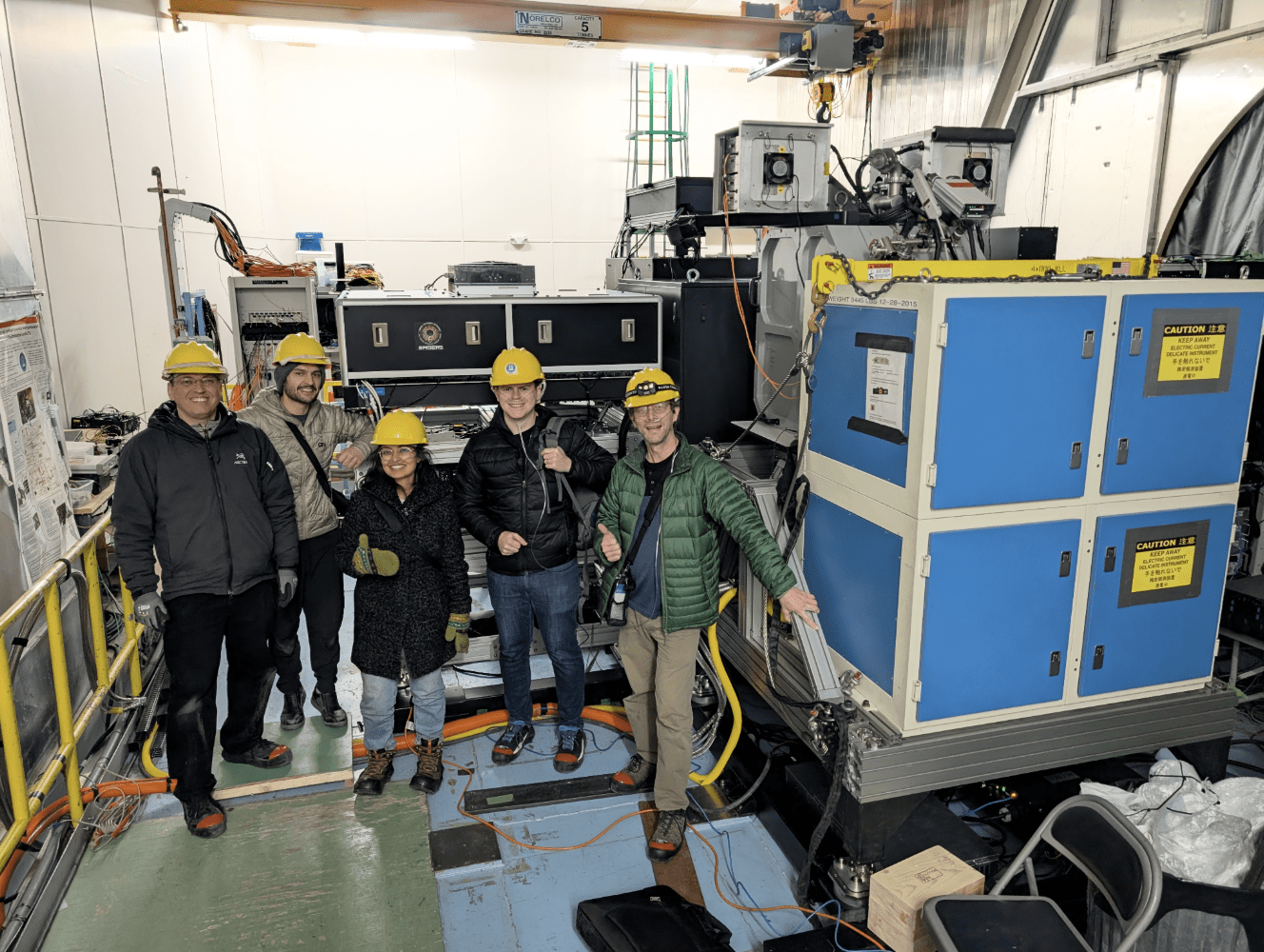
A few members of the SPIDERS team at the Infrared Nasmyth platform of the Subaru Telescope, posing in front of the SPIDERS instrument. From left to right: Dr. Christian Marois, Dr. Adam Johnson, Dr. Garima Singh, Dr. William Thompson, and Dr. Olivier Lardière.
Credit: Dr. Julien Lozi
Every day brings new discoveries of planetary bodies that may or may not resemble the planets in our Solar System. We have found planets that are Earth-sized, hot Jupiters, mini-Neptunes, and supergiants. Some of these worlds are covered in lava; others are wrapped in oceans or ice. There are worlds that have iron rain falling from their skies while others drift alone through space, untethered to any star. We now know ours is just one of many solar systems in the universe.
Finding these exoplanets is challenging, and developing the technology to capture a family portrait of planets and their extrasolar systems is an instrumental achievement. The National Research Council of Canada (NRC) Herzberg Astronomy and Astrophysics Research Centre has developed a state-of-the-art instrument that could allow us to take images of planets on the scale of our solar system, a goal not yet achievable with current methods.
The Subaru Pathfinder Instrument for Detecting Exoplanets and Retrieving Spectra (SPIDERS) is now installed at the Subaru Telescope. In this Shadow the Scientist session, participants will join the SPIDERS team live from the control room as they test their technology on the telescope. Along the way, you will hear the story of SPIDERS’ journey from Canada to Hawaiʻi, learn how students helped build the instrument, and get a sneak peek at its testing on targets that may host planetary companions.