
Beyond the Classroom: One Student’s Quest to Understand Barium Stars
Natalie Tosta, a senior at Waipahu High School, never had an interest in astronomy until she witnessed her first partial lunar eclipse.
“It was around five years ago. I really loved the thrill of staying up late and then waiting for the sky to change. Ever since I witnessed the moon change colors, I wanted to learn more things about space,” said Natalie. “Before that experience, I had no ties to astronomy. I wanted to be a financial analyst because it was one of the suggestions I saw for people who are good at math. I thought that’s what I would do, until I saw the lunar eclipse.”
Inspired by the experience, Natalie eventually enrolled in an astronomy class at her school in 2023 taught by Mr. Justin Bergonio, the lead teacher for the Waipahu High School’s McInerny Foundation Research Observatory. This 12.5-foot rooftop observatory houses a 17-inch teaching telescope right on campus, helping students like Natalie learn about the fundamentals of astronomy and STEM fields.
Through the observatory and Mr. Bergonio’s class, she learned about opportunities for students to dive deeper into the field of astronomy. One of those opportunities was Maunakea Scholars, a program that empowers Hawaiʻi public high school students by supporting scientific inquiry and competitively allocating observing time on world-class telescopes to local students.
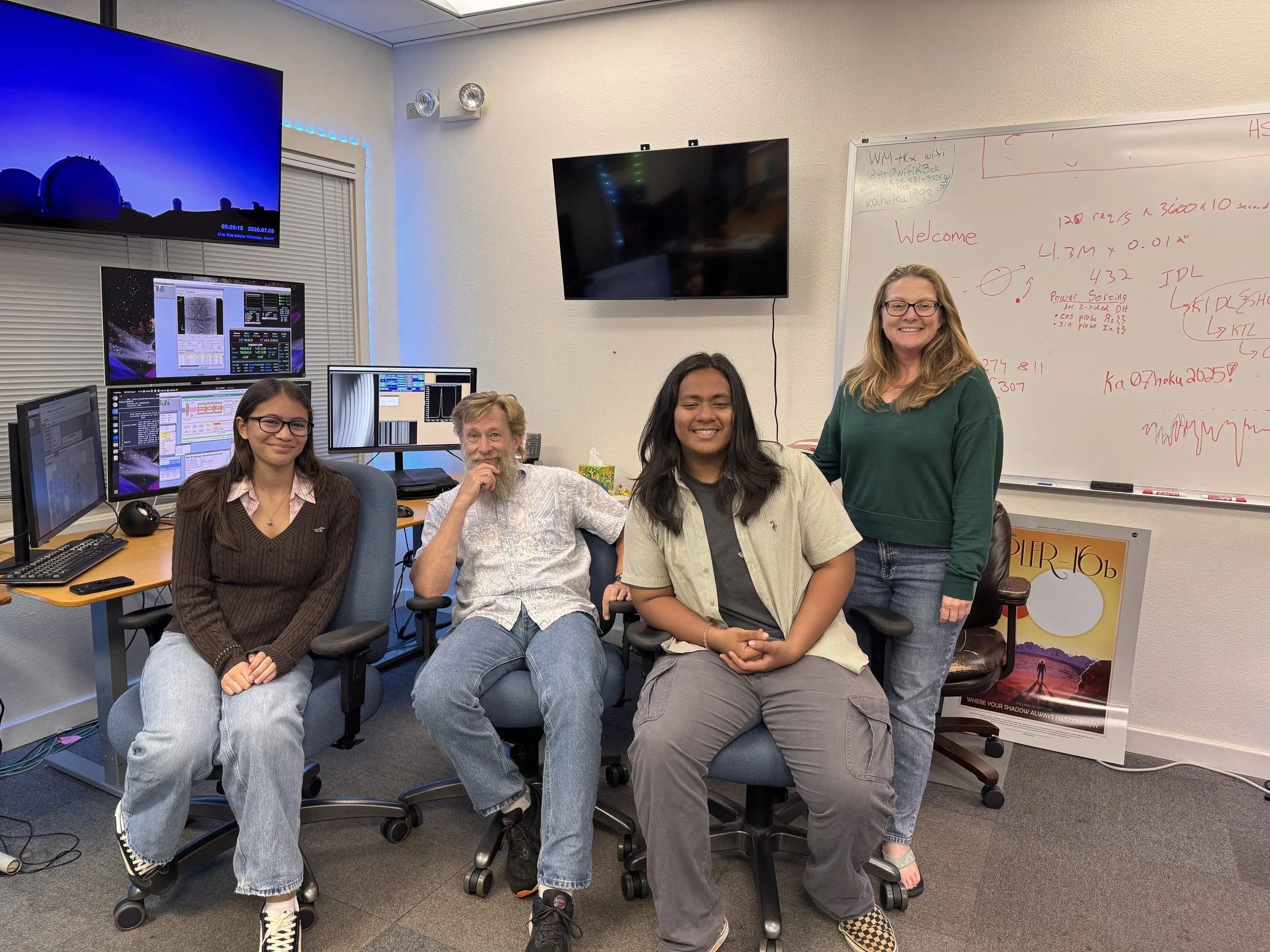
Mary Beth Laychak (right) and Natalie Tosta (left) with fellow STEMworks intern Elijah Cox and Grant Hill, Keck Observatory technical operations manager.
Mary Beth Laychak, Natalie’s mentor for both Maunakea Scholars and her senior capstone project, shared that “The goal isn’t necessarily for them to be an astronomer. The goal for them is to feel empowered as somebody who can understand science and achieve hard things.”
More than 1,000 students have participated in Maunakea Scholars since the program began in 2015. The students apply for observing time and are evaluated against other students at their school for the opportunity to conduct observations with world-class, specialized instruments at the observatories. Competition can be fierce, and Natalie applied twice — first in 2024 and again in 2025 — before being awarded telescope time.
“I felt so excited that I got the time because it meant I was really starting to get into the field [astronomy]. I knew once I got time I would be able to use [the data] for my STEM capstone project,” said Natalie.
Her goal was to study a barium star in the WeBo1 planetary nebula, a glowing cloud of gas and dust located about 5,000 light-years away in the constellation Cassiopeia. Natalie’s interest in barium stars started after she saw NASA’s Astronomy Picture of the Day, which described a planetary nebula near the Heart Nebula. She researched what else was nearby and found reference to WeBo1 and a barium star, something she had never heard of before. It sparked her curiosity, and from there, her research topic came into focus.
This summer, Natalie was able to use her telescope time while also participating in the STEMworks Innovation Internship, a 7-week paid program through the Maui Economic Development Board, Inc.’s Women in Technology project. Natalie was matched with the W.M. Keck Observatory and the University of Hawaiʻi Institute for Astronomy. In preparation for her telescope time, she learned about coding using Python and Jupyter Notebook.
“I went to the Big Island to Keck Observatory headquarters to get my data and met so many great people — actual scientists and astronomers. Even though it was 20 hours a week for seven weeks, it didn’t feel like working. It was like a passion project, really,” she said.
Even then, her research would not come easy. Studying barium stars is challenging. WeBo1 is a niche, binary system with only one star visible to astronomers and requires detecting a specific element: barium. Moreover, the tool she needed for her research — the Echellette Spectrograph and Imager (ESI) — was located at the highly competitive Keck Observatory.
A 27-year-old Keck instrument, ESI splits incoming light into its separate wavelengths to record a spectrum, helping scientists identify chemical makeup, temperature, and speed. Natalie was the last researcher to use the ESI before it was officially retired on July 9, 2026.
Some of ESI’s early results were critical to learning about galaxies early in the universe. Those early findings drove the effort to create two other Keck instruments: the Near-Infrared Echellette Spectrometer (NIRES) and Keck Cosmic Web Imager (KCWI).
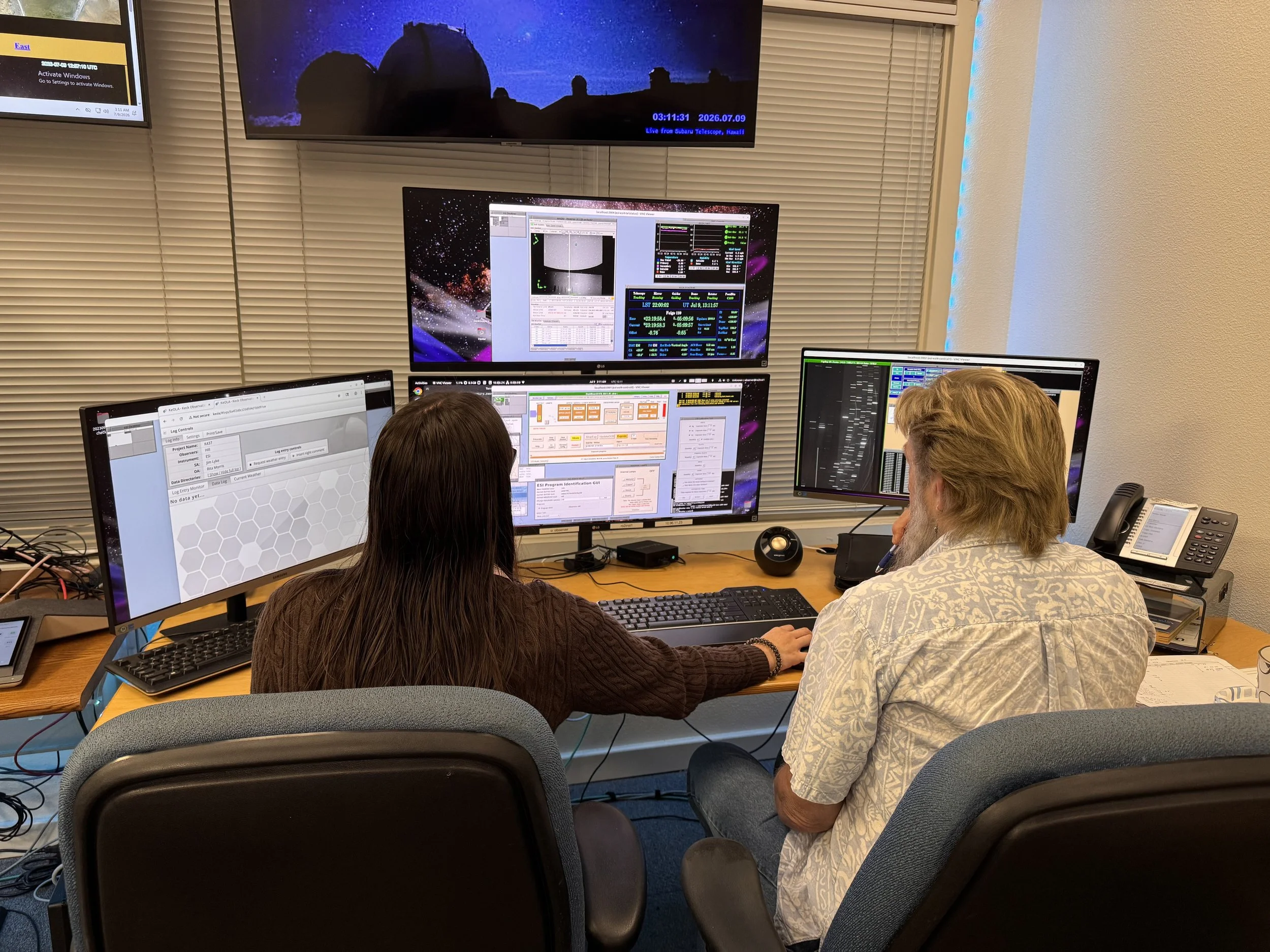
Thanks to her strong research proposal, Natalie secured telescope time with ESI from 2 a.m. to 5 a.m. on July 9. She worked with Dr. Grant Hill, who helped her calibrate the spectral data by starting with a comparison star, and supported her as she guided the telescope operator to move the telescope toward the correct position in the sky.
“Throughout the whole time, [Dr. Hill] let me actually guide the telescope. I was able to do the operations. I was talking to the telescope operator, who actually is there on Maunakea, so I would tell her commands like ‘open the hatch, close the hatch, move it to that certain angle.’ So that was really cool, doing what the professionals would be doing,” she said.
The most interesting thing Natalie has learned from her research on the barium star is that it gets its elements from a companion star.
“Most of the time [a barium star] is not alone. It has a companion that helps it get to the stage that it’s at with all of the heavy elements,” Natalie shared. “I think it’s sort of like a metaphor for life. You can’t get through life without your support system that gives you the resources and opportunity to get to where you are. The barium star could not be what it is without the help of the companion.”
Like the barium star, Natalie has grown into who she is with the support of her mentors, teachers, family, and friends. Mary Beth has had the pleasure of witnessing Natalie’s growth over the years.
“I’ve seen the boost in [her] confidence, especially over the summer. She is emailing professional astronomers and having conversations with them about science. When she went to observe at Keck, she got put on the spot and had to give her elevator pitch about her topic. I don't think Natalie as a freshman could have done that. Anytime I see that confidence boost, especially in young women and others underrepresented in science, it’s just amazing,” said Mary Beth.
Through her participation in the mentorship programs, Natalie gained clarity on her future plans. She is currently taking college courses to get her associate’s degree in science and plans to major in astronomy or astrophysics in college.
“I feel like my love for space has grown tremendously, and I can’t wait to go beyond the surface level,” said Natalie. “I feel like my research capabilities have grown as well. Overall, I feel like I’ve grown as a woman in STEM. I feel more empowered to do what I want in the future.”
