
Hawaiian Skies: Ikiiki 2026
Ikiiki 2026 (Mei 17 - Iune 14, 2026)
Na Leilehua Yuen, Hawaiʻi Culture and Language Resident at Gemini / NOIRLab
The humid days, blanketing clouds, and sticky heat certainly make this month live up to its name, Ikiiki.
One of the ʻōlelo noʻeau collected by Mary Kawena Pukui says, “O Ikiiki ke kāne, o Hoʻopaupauaho ka wahine, hānau ke keiki, he keiki huhū koke.” Ikiiki is the husband, Hoʻopaupauaho is the wife; a child born to them has a short temper.
Storytelling in the Stars
I often speak about how the night sky is not only a calendar, clock, and map; it also holds illustrations of story after story that unroll across the sky. Let’s start with the Komohana (West) horizon, as the stars there will set soon.
The most prominent huihui in Komohana is Nā Kao, “The Darts.” Nā Kao are the belt and sword of the Western constellation Orion, Kuʻukuʻu in Hawaiian, “the spider,” which crawls along its thread, Ke Alanui a ke Kuʻukuʻu, the celestial equator. The Polynesian Voyaging Society name of this ulu hōkū is Heihei o nā Keiki, the Children’s String Game. Depending on how you learned the story, either the stars themselves are darts or the stars are puka (holes) in the sky left by darts. In an ʻoli that we chant to greet the dawn, Nā Kao are mentioned as having leapt to heaven, indicating that it is morning.
Nā Kao – The Darts
Click to view in detail - Credit: NOIRLab/NSF/AURA/L. Yuen
E ala ua ao, ua mālamalama
Ua hele kanaka aia i luna
Ua kaiao ka ho‘okā ula ka ho‘okā lei
Ua kani ka moa kane, ua kani ka moa wahine
Mahiki Nā Kau, lele i ka lani
Arise, it is day, it is light
People are up and about
Dawn has burst forth, shattering night
The rooster has crowed, the hen has clucked
The Darts have leapt to heaven
ʻAua, Betelgeuse shows itself ma luna (toward the zenith) of Kuʻukuʻu. ʻĀua refers not only to Betelgeuse but also to Capella. The two ʻAua appear to rise simultaneously when you are at 28° north latitude. Kure, the northernmost atoll in the Hawaiian archipelago, is at 28° north. Coincidence? I think not!
This month, as we are storytelling, we will use the inoa (name) Hōkū-lei for Capella. Hōkū-lei is also the name for the ulu hōkū of the Winter Hexagon. Archaeoastronomer Maude Makemson suggested that Hōkū-lei may also be Auriga. While both Auriga and the Hexagon are dramatic, to me, the way the Hexagon brackets Hikina, the east, on rising and touches so many important stars makes it the stronger candidate.
Inside the Winter Hexagon, we find Hōkū-kau-ahiahi, Venus. This hōkū-hele (planet) bears one of the most beautiful names I know for a star. Venus has many names, but Hōkū-kau-ahiahi translates to English as “Star Placed in the Evening.” Another hōkū-hele inside the circle this month is Ikiiki, Jupiter.
As a Haʻi-moʻolelo, a storyteller, I love the way the huihui and ulu hōkū make pictures to illustrate the moʻolelo, stories. Since I am using the stars to tell these stories, I like to call them moʻohōkū.
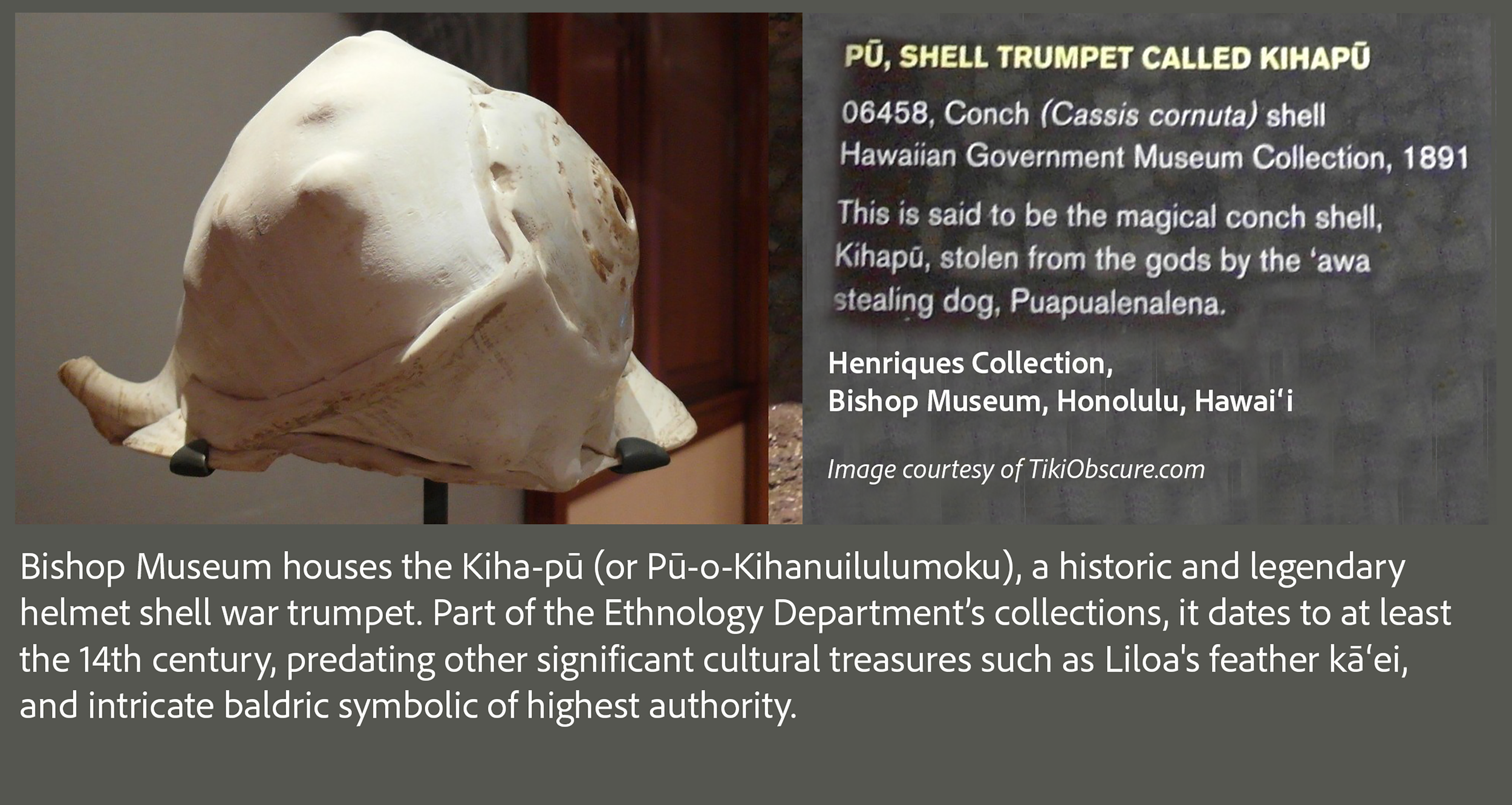
The Kiha-pū, the Shell Trumpet of Chief Kiha, is seen in Western astronomy as the head and mane of Leo. The mouthpiece of the trumpet is formed by Ikiiki, Regulus. Notice that we have three Ikiiki this month! The month is Ikiiki. Ikiiki is one name for Regulus, and Jupiter also is Ikiiki.
Many children in Hawaiʻi grow up with stories of the magical dog, Puapualenalea. In the storytelling I learned, that role is played by Ursa Major. Last month we were calling this ulu hōkū ʻĪlio, dog. A reminder that Hawaiʻi has only two endemic mammals: ʻŌpeʻapeʻa, the Hawaiian hoary bat (Lasiurus semotus), and ʻĪlio-holo-i-ka-uaua, the Hawaiian monk seal (Neomonachus schauinslandi). ʻĪlio (dogs), puaʻa (pigs), and ʻīole (rats) all were brought by Polynesian settlers.
Puapualenalena was a kupua, a supernatural being in the form of a great yellow dog. There are many versions of the Puapualenalena story. On Kauaʻi, one of his names is Puʻulena. In this moʻolelo, Puapualenalena lived in Waipiʻo, the great valley on Hawaiʻi Island, famous for being where Paiʻea Kamehameha was reared.
Puapualenalena and the Kiha-pū
Puapualenalena lived with an old man. He dearly loved the old man and took good care of him, bringing him food and whatever he might need. Where the items came from was sometimes questionable.
The pair was looking for a home, and after many days of travel they settled in Waipiʻo. The dog had chosen this valley because Kiha Aliʻi, Chief Kiha, had extensive loʻi kalo, taro paddies. Also, excellent quality ʻawa (kavakava) grew there. Once they set up their humble home, Puapualenalena set out to fill his human’s other needs. This included ʻawa to ease his human’s aching bones.
One night Puapualenalena had dug up a particularly healthy ʻawa root and was carrying it home to his friend. One of Kiha’s men spotted the dog and captured him. Kiha demanded that the dog’s owner be brought to him to see the dog’s execution. The old man loved the dog very much, like a child, and offered his own life in exchange for the dog’s.
About this time, and for the past several months, a band of ʻeʻepa, mischievous supernatural beings, was living high on the Koʻolau (north) wall of Waipiʻo. They would carouse all night long, drumming, laughing, and shouting. The din echoed off the valley walls. But even worse, they had a pū, a shell trumpet, which they blew throughout the night. It was so loud that no one could sleep.
The old man told Kiha that his dog could capture the pū and bring it back. Kiha decided that if the dog could do this, he would set the old man free. If the dog could not, then both would be executed.
As soon as the chief finished speaking, Puapualenalena ran to the Koʻolau wall of the valley and disappeared into the bush. That night, the drumming and trumpeting were louder than ever! Puapualenalena had gone to the camp of the ʻeʻepa and was cavorting like a puppy, playing tricks and making the ʻeʻepa laugh. They enjoyed his antics so much that they fed him and allowed him to stay with them. They played the drums and blew the pū even louder to make the dog dance. Puapualenalena leaped and spun about merrily; he danced and played like the funniest puppy imaginable. The ʻeʻepa did not notice that he was dancing ever closer to the one holding the pū. He played at the ʻeʻepa’s feet, squirming and wriggling and wagging his tail. Suddenly, with one leap into the air, he snatched the pū and ran down the valley path! He ran as fast as he could. Then using his kupua powers, he ran even faster!
He ran down trails, past waterfalls, and across streams until he reached the hale (home) of Kiha, where he set the pū down between them and sat thumping his tail on the ground.
Kiha set the old man free and gave Puapualenalena the right to harvest ʻawa and kalo from his personal patches as long as the old man lived.
The trumpet, henceforth known as the Kiha-pū, is now in the Bishop Museum in Honolulu.
Click to view in detail - Credit: NOIRLab/NSF/AURA/L. Yuen
Kapeʻa, Crux, peers above the Kona, southern, horizon. This is another ulu hōkū with a multitude of names. Those found so far: Hānai-a-ka-malama, Hōkū-keʻa, Hōkū-keʻa-o-ka-mole-honua, Humu, Kao-ea, Kapeʻa, Kaulu, Makeaupeʻa, Mekeaupeʻa, Newa, Newe, Newenewe, Wenewene.
The navigational stars Hikianalia (Spica) and Polapola (Hadar) are visible, along with Hōkūleʻa, Arcturus, our own zenith star.
As hurricane season nears, Ka-ipu-makani-o-Laʻamaomao, Boötes, with Ka-ua-mea, Corona Borealis, become more prominent in the sky. Ka-ipu-makani-o-Laʻamaomao is the ipu, or gourd, that holds the makani, or winds, and when the lid is taken completely off the ipu, all of the winds escape, creating hurricanes. Ka-ua-mea, one translation being “rain maker,” accompanies it.
Across the predawn sky, the Milky Way shimmers. We can see ʻAi-kanaka, the shark ancestor of Māui, swimming through the heavens. The Milky Way is another of those celestial phenomena that have numerous inoa, names. The more I work with it, the more I believe many of the names have to do with regions of the Milky Way, rather than the Milky Way as a whole. I would love to hear your thoughts.
Hōkū-noho-aupuni (Ruler of Stars), Lālani (Row), and Pae-loa-hiki (Reach Across) all, I believe, refer to the Milky Way as a whole. Ka-haʻi and Mōhaʻi, both translating to English as “break,” make a dark break in the Milky Way between Perseus and Auriga.
Ka Iʻa (The Fish), Iʻa-lele-i-aka (Fish Leaping In Shadow), ʻAi Kanaka (shark ancestor of Māui), and Kau (summer), I believe, are references to the great fish-like shape, with Kau reminding us that it appears during the summer months.
Now Mānai-a-ka-lani, the line for Māui’s fish hook, and Ka-makau-nui-o-Māui, Māui’s Fish Hook, combined are known also as Scorpius, appear with the great ulua Pimoe (the Teapot constellation). Lehua-kona, Antares, is the knot that ties the leader to the line. Au-haele, Al-Niyat, and Pai-kauhale bracket Lehua-kona. Originally, Al-Niyat, “the veins,” was the name for both of the companion stars. When the International Astronomical Union (IAU) gave the stars separate names, they selected the Hawaiian name, Pai-kauhale, for the eastern star.
Lying atop the tail of ʻAi-kanaka is Ka-lupe-a-Māui, the kite of Māui, one of three kite-like ulu-hōkū in this season’s sky. My drawing of the kite here is based on a petroglyph in Kaʻupulehu. There are said to be natural features in Hīlea, Kaʻū, which correspond to this moʻohōkū. I’m still researching this ulu hōkū, so the image may change as I learn more!
We have two more kites in the sky, a bit smaller. The first is Ka-lupe-o-Kauahoa, together with Ka-lupe-o-Kawelo, they are known to Western astronomy as Pisces. Kauahoa and Kawelo were boys whose kite strings got tangled. Kauahoa’s kite string broke, and his kite sailed away. But he remained friends with Kawelo, who later became a famous aliʻi.
Makulukulu, Saturn, and horizon. Hōkūʻula, Mars, is on each side of nā lupe (the kites).
