
Subaru and Keck Help Discover Two Rare Companions in Distant Solar Systems
Subaru Telescope and W.M. Keck Observatory helped discover two rare companions orbiting distant stars – a giant planet, which provides insight into how planets form, and a brown dwarf that could play a starring role in new NASA missions that work towards imaging Earth-like worlds. The first results released from Observing Accelerators with SCExAO Imaging Survey (OASIS) successfully combined the unparalleled imaging power of the Maunakea Observatories with sophisticated instruments in space-based telescopes. The results were published in The Astronomical Journal and The Astrophysical Journal Letters.
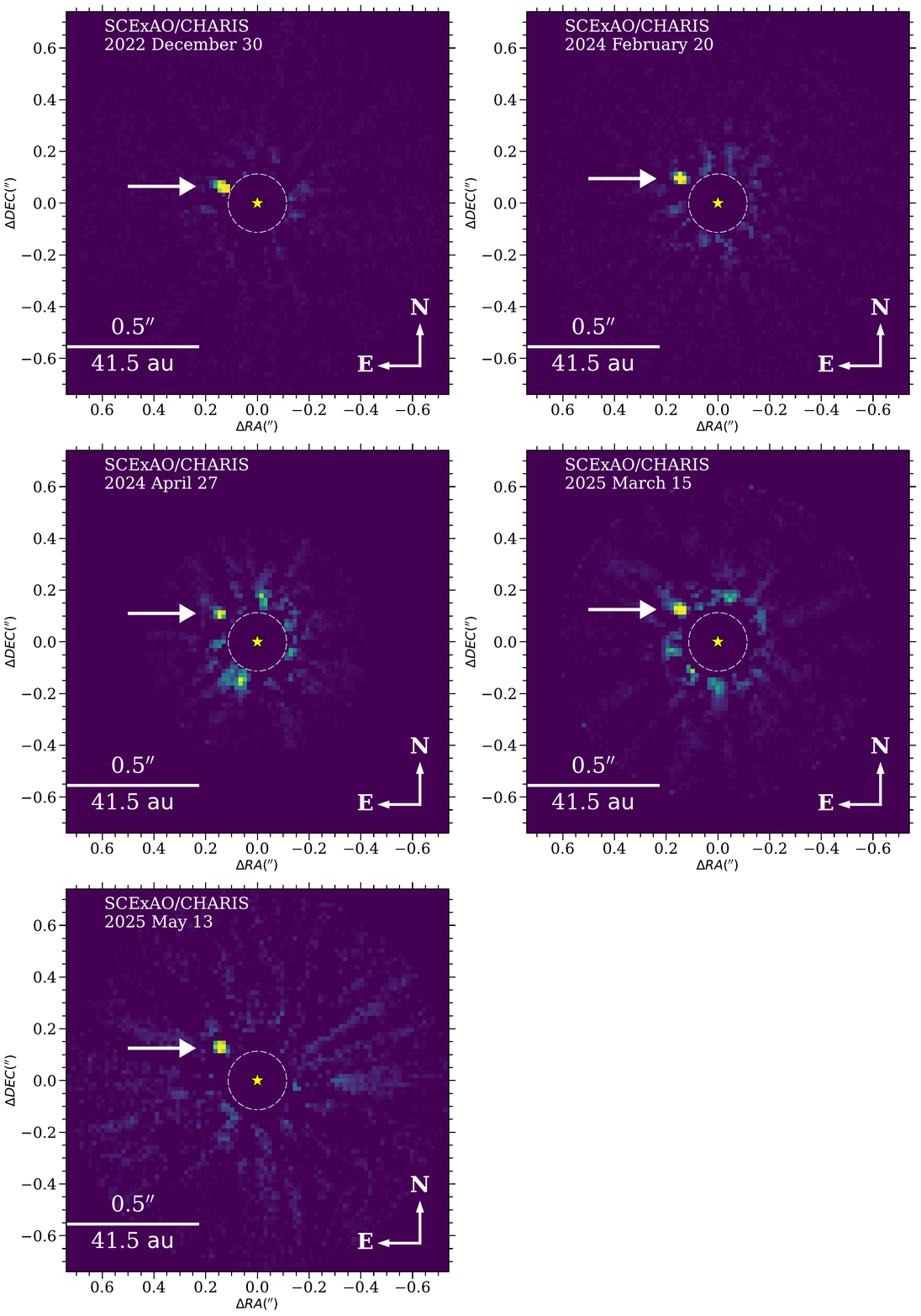
NIRC2 image of HIP 71618B indicated by the white arrow denotes the position of HIP.
Credit: T. Currie / W.M. Keck Observatory
Maunakea Observatories Come Together
The new OASIS images were made possible by a collaboration between Subaru Telescope, W.M. Keck Observatory, and the European Space Agency (ESA). Researchers combined the capabilities of the space-based ESA telescopes and the ground-based Maunakea telescopes, along with archival data, to investigate distant stars for hidden companions.
First, researchers used measurements from the ESA’s Gaia and Hipparcos space satellites to find their targets — “accelerating stars,” stars whose movement indicates they are being pulled on by the gravity of an unseen object, possibly a giant planet or brown dwarf. Planets and brown dwarfs that are detectable by imaging are uncommon, and previous efforts to find them yielded a very low rate of discoveries, “but with this new information in hand, we then knew where to point Subaru and Keck to detect the planets and brown dwarfs,” explained Dr. Thayne Currie, professor at the University of Texas-San Antonio and the lead researcher of OASIS.
Once the target stars were determined, researchers used Subaru Telescope’s SCExAO advanced adaptive optics system to “detwinkle” the stars, taking high-contrast images of these solar systems in order to detect the presence of hidden companion objects. Once combined with Keck Observatory’s NIRC2 camera, which provided longer wavelength measurements, researchers were then able to characterize the atmospheres and orbits of these companion objects — determining them to be a massive planet and a brown dwarf star.
Lead researcher Dr. Thayne Currie has been building up to this project for over a decade, starting with a Subaru-led survey called SEEDS. SEEDS was a forerunner to this project, which tested out similar adaptive optics systems on a broader range of planets. Since then, the technology has continued to improve immensely. Gaia and Hipparcos can narrow the search down from the thousands of visible stars in the sky to the select few with hidden companions. Now, Subaru has arguably the world’s most advanced adaptive optics (AO) system, yielding sharper images than even the James Webb Space Telescope, and Keck’s NIRC2 camera is so well-calibrated that we can measure the positions of planets and brown dwarfs around stars with extreme precision.
“These instruments work so well because Maunakea is the best active site on Earth for imaging planets around other stars,” Thayne explained. The success of these recent discoveries builds upon the work he and others have been developing for nearly 15 years and the amazing benefits of Maunakea as the world’s best location for astronomy.
A Global Team, Connected by Maunakea
A huge team, based both on Maunakea and around the world, contributed to these massive discoveries. Over 30 members spread across the globe contributed to the research, spanning from planet atmosphere experts to students working on their first-ever research project. While Thayne oversees the project and processes much of the data, he said that every member has a very important role to play. He said this especially wouldn’t be possible without the technicians who operate the extremely complex instruments used at Subaru and Keck. “They are the ones who make our science possible in the first place,” said Thayne.
Brown Dwarf Paves the Way for Future Research
One of the companions discovered is the brown dwarf star HIP 71618 B, which is 169 light-years away from us in the constellation Bootes and sixty times as massive as Jupiter. A brown dwarf, sometimes called a “failed star”, is larger than a planet but not big enough to sustain nuclear fusion in its core, like our sun does. This means they only emit the energy that was required to form them, slowly cooling and dimming over time — making them much fainter than typical stars, and harder to detect.
HIP 71618 B is the very first object that is suitable for testing the capabilities of NASA’s Roman Space Telescope, which is set to launch in 2027. Scientists at NASA have been looking for an object to demonstrate the efficacy of Roman’s coronagraph system, but so far, they haven't been able to find an ideal test subject. A coronagraph blocks much of the light from a star, reducing its glare, so that scientists can see faint things like planets and brown dwarfs near the star. And amazingly, HIP 71618 B is just the right fit for the job — it has a bright host star, an ideal distance between it and the host star, and is just faint enough to challenge the Roman’s coronagraph system and hopefully demonstrate its ability to perform. It also has a prime location in the sky and is visible from the Roman space telescope year-round.
“I felt quite lucky when we realized this brown dwarf we’d discovered would be a good fit for the NASA mission,” said Thayne. “It was one of the very first stars we looked at, and everything seemed to fall into place with this system.”
The Giant Planet
But the exciting discoveries didn’t stop there. Researchers also discovered a giant planet, HIP 54515 b, 271 light-years away in the constellation Leo. This planet orbits at a similar distance from its host star as Jupiter is to our sun, but it is 18 times more massive than Jupiter.
A common analogy is trying to detect a planet next to a star is like trying to spot a firefly next to a lighthouse. “The planet is about 10,000 times fainter than its star, and it is located very close to its star on the sky; its separation is comparable to the apparent size of a football viewed over 200 miles away. Trying to detect this planet — let alone learn anything about it — seems completely absurd,” Thayne said. But the team was able to do it, thanks to Subaru and Keck’s instruments and the “unrivalled quality of Maunakea as an astronomical site.”
The comparison to Jupiter is useful not just as a benchmark for size — as it is by far the most massive planet in our solar system — but because Jupiter played a critical role in shaping the evolution of our solar system, including the Earth itself. The more we learn about Jupiter-like giant planets, the better we can understand how gas giants form and how their orbits and atmospheres come to be.
What Comes Next
As they tend to do, new answers lead to new questions. For Thayne and his team, the discovery of the giant planet and brown dwarf opens up many more questions — for example, why do many of these new giant planets have more eccentric (non-circular) orbits than Jupiter does? Is the same true for brown dwarfs? What do brown dwarfs and giant planets have in common — in their atmospheres and orbits?
“Right now, we are trying to use our discoveries to piece together a “fossil record” of how the atmospheres of planets and brown dwarfs change with time,” explained Thayne. “We are interested in applying the same technique — using Gaia and Hipparcos data plus imaging with Subaru and Keck — to scout some of the nearest star systems: the kind around which we may one day be able to image another Earth.” Eventually, NASA also hopes to use Roman’s new coronagraph system to detect increasingly smaller and fainter planets — getting us closer to finding Earth-like habitable worlds. Subaru and Keck’s discoveries hope to contribute to that mission, and these two new images from the OASIS team are a good sign that we’re heading in the right direction.
