
The Sylvester Family: Three Generations of Astronomy
Tony Sylvester and his son, Anthony, stand in the Gemini base facility control room watching a familiar sight unfold: images of a windswept Maunakea summit viewed from multiple angles. Between the two of them, they have worked for 36 years in astronomy on Hawai‘i Island.
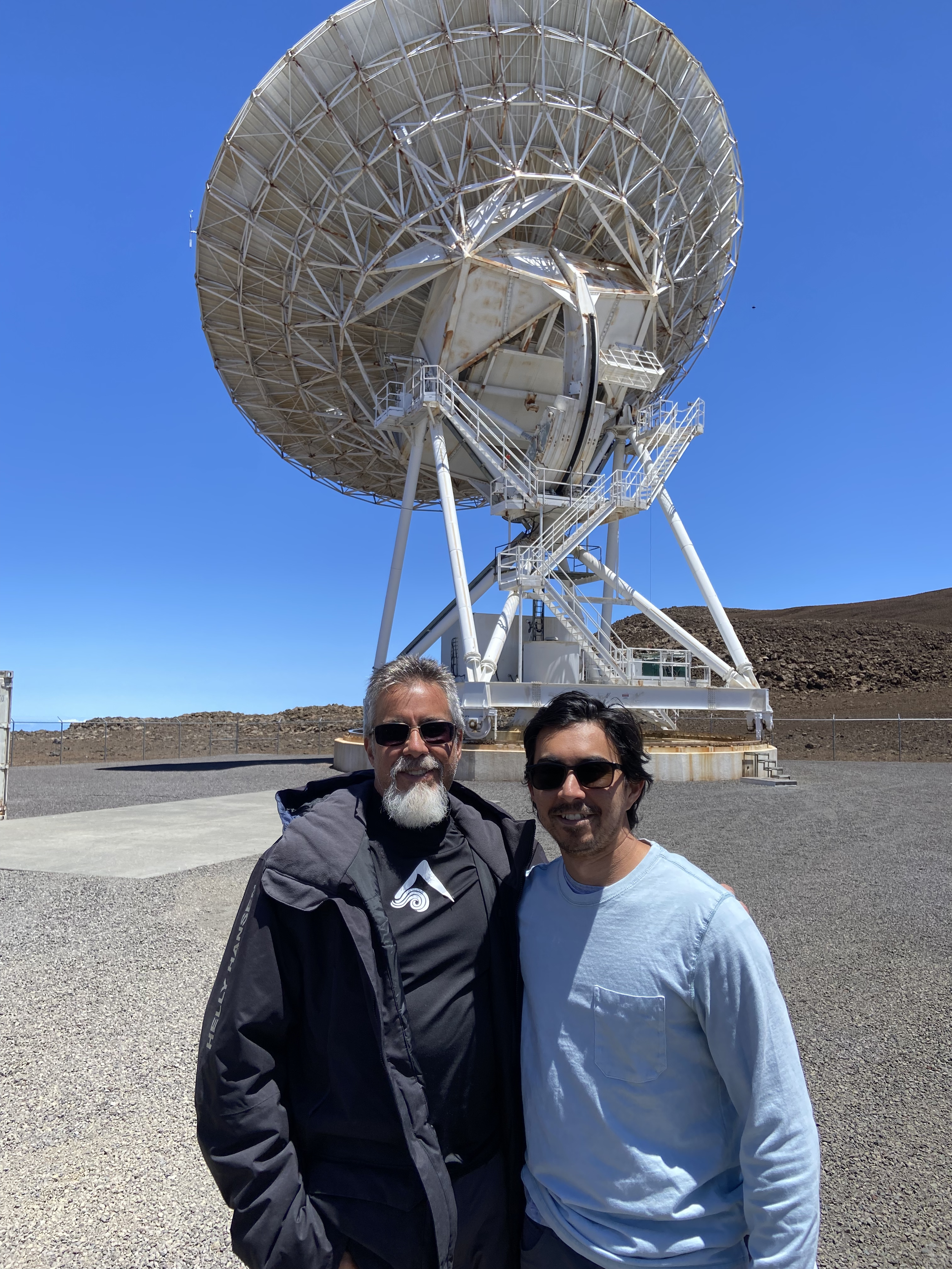
Tony Sylvester (left) and Anthony Sylvester (right) stand in front of the National Radio Astronomy Observatory (NRAO)
Tony, 61, and Anthony, 36, are the second and third generations of their family to work for Maunakea Observatories. Anthony is a software engineer for Gemini Observatory, and Tony is the site manager for the National Radio Astronomy Observatory (NRAO).
Their family’s legacy in astronomy started with Tony’s late father, Anthony Sylvester Sr. In 1972, Anthony Sr., a machinist who studied aeronautics, used his experience repairing airplanes to get a job working night shifts as a telescope operator at the University of Hawaiʻi 88-inch telescope (UH88), where he eventually worked his way up to superintendent.
“There were only two or three telescopes there at the time. So, it was something very, very remote, rare, and isolated. It was a prestigious place to work,” said Tony. Back then working on the mountain meant driving three hours across a potholed Saddle Road to reach the summit and then camping overnight.
Because of Maunakea’s remoteness and the few opportunities available, Tony never imagined he would follow in his father’s footsteps. Instead, at the advice of his dad, he pursued a career in electronics, an emerging field in the 1980s.
“One day [my dad] came home, and he had looked into an [electronics] program for me on O‘ahu. He asked if I was interested in going and I said, ‘sure!’ It was Hilo in the 1980s. Not much was going on, and I was ready to go somewhere,” Tony said with a laugh.
After graduating with his electronics degree, he moved to California to work in research and development at Hughes Aircraft. He married his wife, Michelle, in 1988 and started a family of his own. He was making strides in his career when he got an unexpected call from his mother in 1991.
She called to tell him his father had passed away after being swept out to sea while fishing at South Point in Ka‘u. Anthony Sr. was just two months shy of retirement.
“[My dad’s passing] forced me back to Hilo. I was four and a half years into my career and doing well. [My father] left behind my mom and my grandma. I had to come back to take care of things,” Tony said.
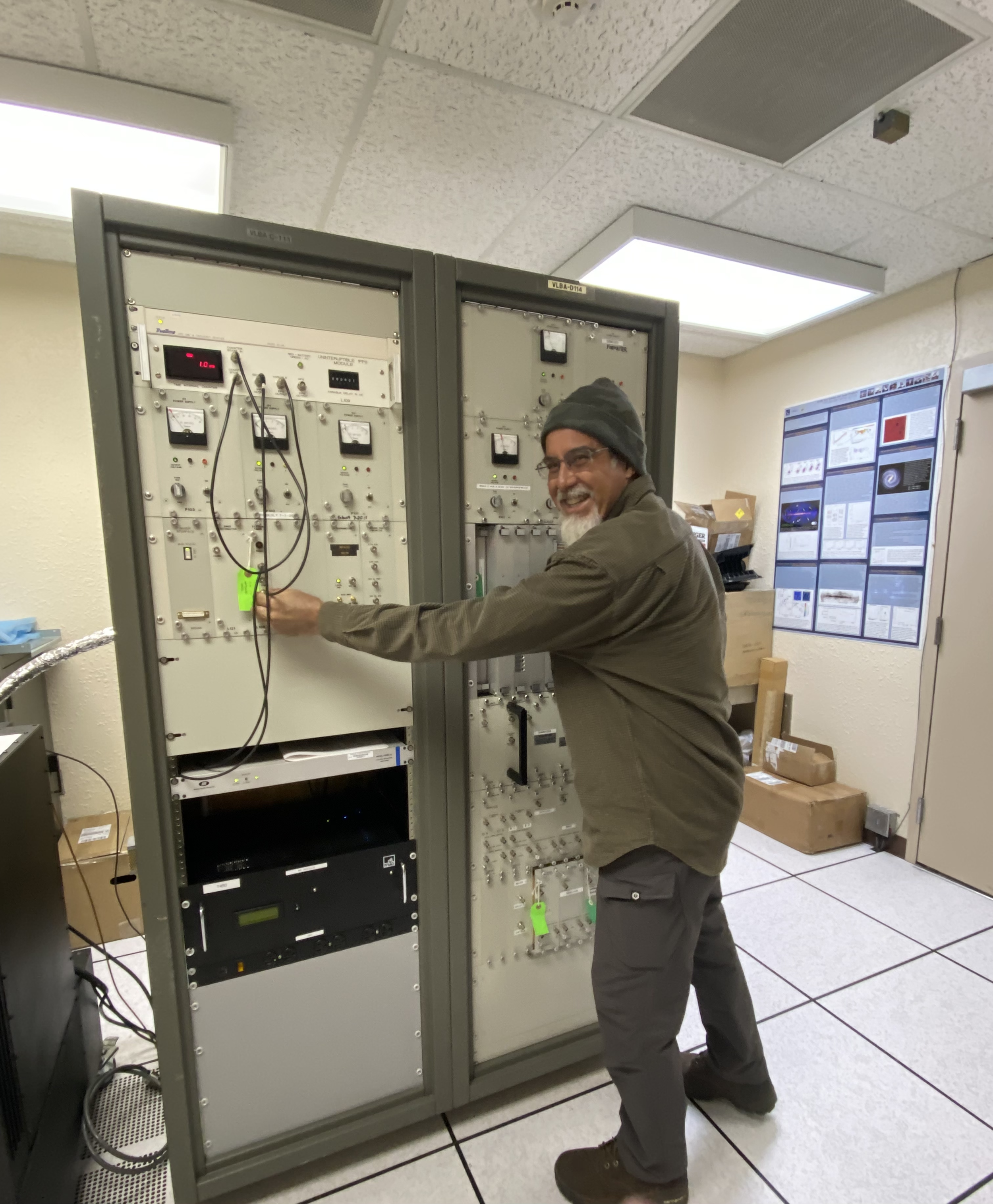
He stayed in Hilo to take care of his family and briefly worked at the Hawai‘i Department of Agriculture as a research assistant before landing a systems specialist job at NRAO in 1992.
Tony and Michelle had four children, three sons and a daughter, and they nudged their kids toward careers in math and the sciences. “When they were young, I would teach them basic calculus, equations, and stuff like that,” said Tony. “By the time they got to the seventh and eighth grades, they already knew the things that were being taught.”
“Both my mom and dad pushed engineering a lot,” Anthony added.
Whether it was a nudge or a push, the early “training” rubbed off on Anthony and his siblings, who would also go on to pursue careers in engineering. In high school, Anthony took accelerated courses in math and science, which earned him a full ride to the University of Hawai‘i at Manoa.
There, he studied mechanical engineering as an undergraduate and graduate student and participated in the Akamai Internship Program, which develops the talents of local students through hands-on experience with telescopes and technology. In yet another full-circle moment of the Sylvester family story, today, he is an Akamai mentor.
After graduation, he used the experience he gained in the UH Manoa robotics program to get a job with an Oʻahu-based underwater robotics company, where he worked for seven years.
Then, the pandemic hit.
“After the whole COVID shakeup happened, I really wanted to move back to the Big Island. The older I got, the more I missed living here. I missed the pace of life, my siblings. They all moved back here,” Anthony shared. “My grandmother was still alive, so I wanted to come back and spend time with my family.”
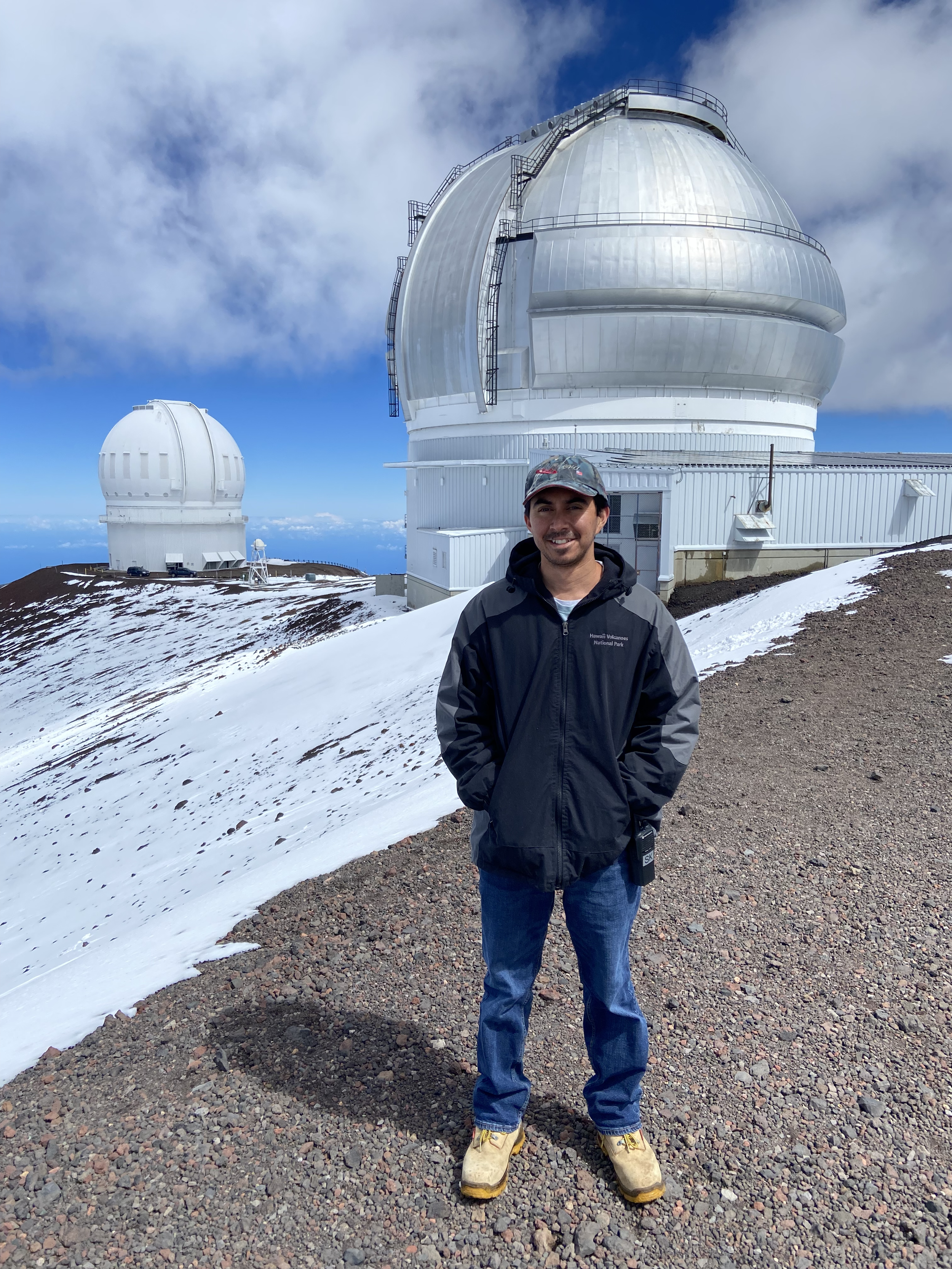
After applying twice, Anthony was finally able to do just that in 2022 when he accepted a software engineer position at Gemini and moved back to Hilo. Though Tony and Anthony are very different people — Tony could carry on a conversation with a stranger for hours while Anthony is quiet and reserved — they share traits that have undoubtedly led three generations of their family to the field of astronomy.
“We all like to understand how things work,” said Anthony. “We get gratification from fixing things and building new things.” In the great debate of nature vs. nurture, the Sylvester family is more likely a testament to both, as Tony said his father was the same way. “My dad would even make his own parts for his car. He was real meticulous and very patient.”
Both father and son agreed that working on the mauna also demands a kind of do-it-yourself mindset that can be hard to find.
“It’s very, very harsh conditions [on the summit]. You have to be comfortable doing stuff outside of your expertise. For example, if you go to the summit and your car breaks down or you need to change a tire, you need to be able to do that yourself. You have to try to fix anything you can,” said Anthony.
Tony described a major emergency repair where the elevation drive motors on a radio antenna failed during a winter storm, leaving an 85‑ton dish stuck and pointing at the ground.
“It took us six hours to move the antenna back up. We burned up two drills, and then we had to use a hand crank. We were hand cranking for six and a half hours, taking turns cranking 85 tons,” said Tony. “My coworker thought I was insane for insisting we do it in the freezing rain. But good thing we did because the next day the winds hit 80 to 135 miles per hour.”
One strong thread that runs through the stories of all three Sylvester men is their deep connection to family and place. Their ancestors came to the Hawaiian Islands six generations ago in 1870 to work on the sugar plantations. They both could have chosen more lucrative careers on the continent, but instead they chose to come home.
These days the entire Sylvester family has dinner every Sunday at Tony’s Waiakea Uka home. Anthony, who Tony calls Ekolu (three), now has a one-and-a-half-year-old daughter.
“I want to do what my parents did and instill [curiosity] in my daughter, too,” said Anthony. “If I see she's interested in something, I want to give her the resources [to learn more] and to understand the mechanics behind why things are the way they are.”
This kind of intentional investment of love and time into the next generation is what Tony says that he and his son really inherited from their ancestors.
“My parents lived through the Depression, plantation camps, and things like that. Every generation, we owe it to our ancestors to improve because they came here with nothing,” said Tony. “They worked hard to improve a little at a time. We need to build on that, otherwise their sacrifices were for naught.”
Their ancestors’ determination and grit to survive difficult circumstances is visible even now in Tony and Anthony when they encounter their own challenges, like fixing an 85-ton antenna on the summit during a winter storm.
By building skills to meet the scientific needs of their generation, Anthony Sr., Tony, and Anthony have each made their mark on astronomy in Hawai‘i. “I think my dad would be very proud,” said Tony. “These kids are on the whole next level. I took a step for myself, and now all my kids are in engineering.”
