
Akamai Interns Shine at 2026 Symposia
The night before she presented her summer's work at the Akamai symposium in Waimea, Ro Lefaoseu was in the machine shop with her mentor. Ro is a mechanical engineering undergraduate at the University of Hawaiʻi at Mānoa, from Wahiawā, Oʻahu. Every two to three years, Canada-France-Hawaiʻi Telescope (CFHT) removes its 3.6-meter primary mirror for maintenance and sets it on a handling carriage whose sensors confirm the load is evenly balanced; after one of those aging sensors was damaged in 2025, Ro designed and machined a replacement assembly and upgraded the carriage's analog displays to digital meters. Her project to upgrade the primary mirror handling carriage for the telescope had experienced delays in materials delivery. But, she enthusiastically told the room, she had used every last minute of her internship to improve her engineering skills on a real-world project that would make a meaningful impact for telescope operations.
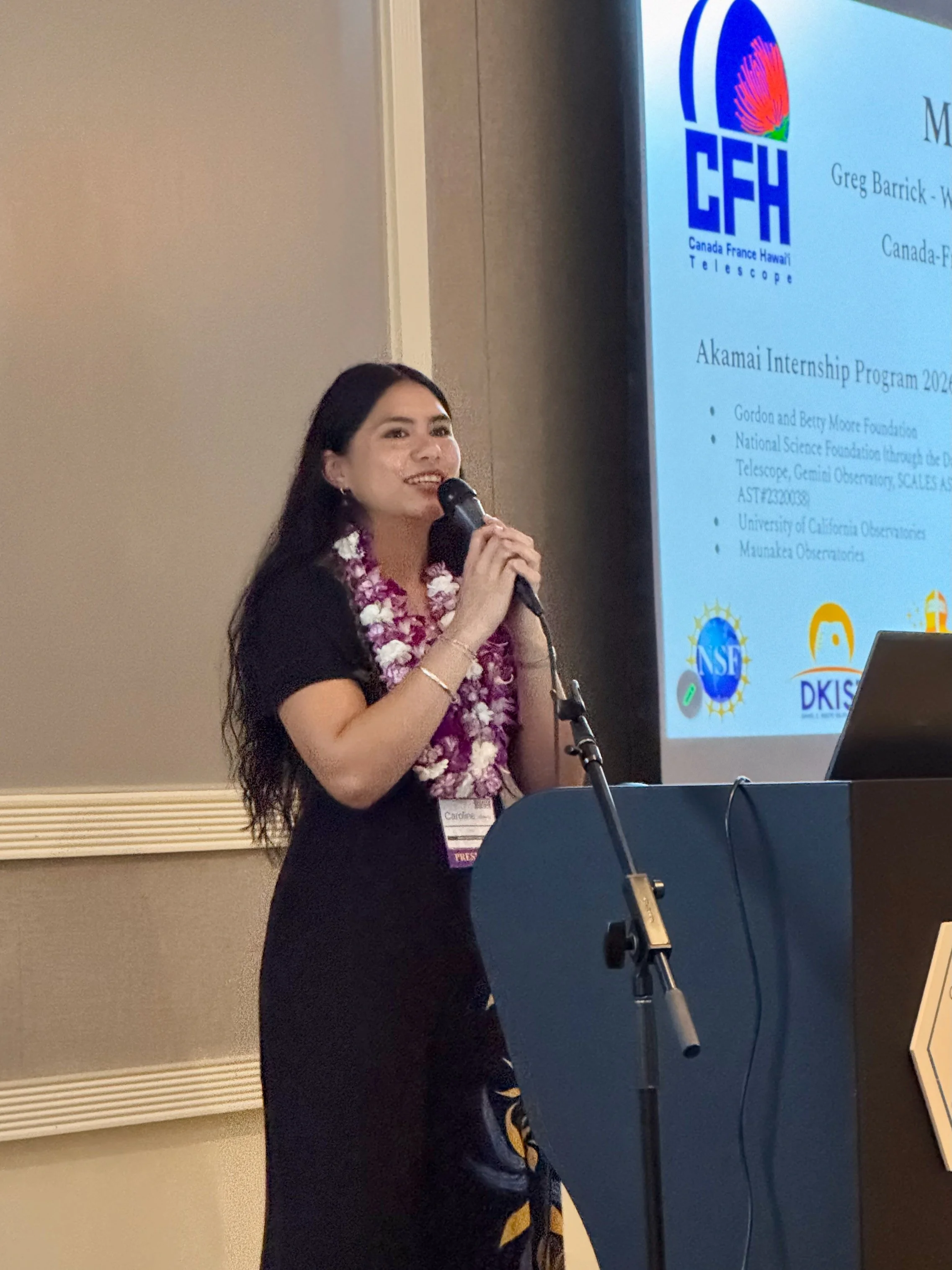
Ro Lefaoseu presenting at the 2026 Akamai Symposium in Waimea.
Ro was one of 28 interns from this year’s Akamai Workforce Initiative internship program who gathered at the end of the summer in events in Kahului, Hilo, Waimea, and Santa Cruz, California. They were joined by their mentors, program faculty, community members, and friends. Each intern showcased their work in a 10-minute talk. The talks were a chance to spotlight the summer's project and also a step toward a professional future, stretching each intern's public speaking and networking skills. Summaries of every project are collected in the 2026 symposium abstract booklet.
The Akamai Workforce Initiative is led by University of California Observatories and has been partnering with Hawaiʻi astronomical observatories and technology companies since 2001 to offer kamaʻāina college students opportunities to gain work experience at an observatory, company, or scientific or technical facility. The Akamai team works with mentors to create intern projects that are meaningful and of value to the partner organization while providing real-world job skills in the process. Significant effort goes into matching interns with projects that align with their background, skills, and interests.
Every cohort of interns from across the island develops its own character, and program staff and mentors say this one stood out. "The enthusiasm of the students for this opportunity to be hands-on in the summer was really evident to us. There was a ton of great energy," said Stacey Sueoka, senior optical engineer at the Daniel K. Inouye Solar Telescope and Akamai Instructor. Ro's late night in the machine shop was a case in point.
Mentors also noted the cohort's maturity and professionalism. Akamai staff work on interns’ professional skills throughout the summer, including working with every intern and their mentor to set professional goals that go beyond the technical project, such as time management and networking. This year's interns took those goals seriously, often contributing their skills and ideas well beyond their assigned work.
Zachary Montondo, a University of Hawaiʻi Maui College student, worked at Maui Electric (MECO) during their internship. Maui Electric's substations rely on backup battery banks to keep critical systems running during power outages, and Zachary built a tool in Excel and Python that compares each substation's expected battery load against measured data, so engineers can make better decisions about repairs and replacements. While their project to work on the DC load calculator and predictive maintenance was humming along, Zachary also took the initiative to offer his coding skills to their summer coworkers to help streamline digital processes outside of his project of focus. Along the way, they learned what it means to be a colleague: part of a team that contributes together to the success of the organization.
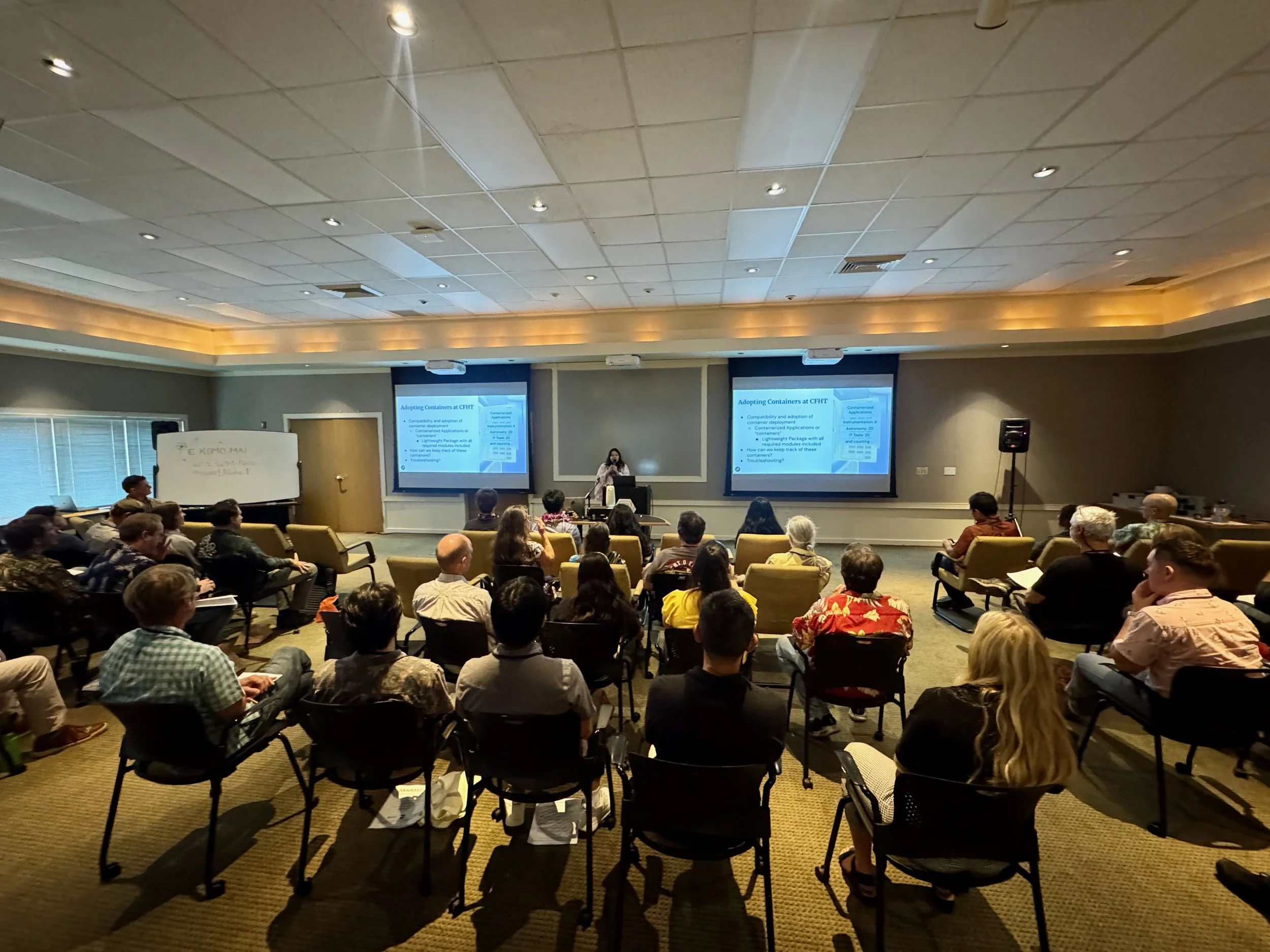
The range and sophistication of the 2026 interns’ projects was impressive. At Gemini North, Isaiah Broderson trained a machine-learning model on roughly 34,000 pointing corrections from 12 years of telescope operations. Tested against past observing nights, it reduced pointing errors by 29 percent, a step toward letting the telescope land on its target without manual correction. At the Daniel K. Inouye Solar Telescope, Caleb DeSoto built the first standardized catalog of planetary passages near the Sun that the telescope could observe through 2070, while Landen Amor Ildefonso developed a modern seismic monitoring system that can alert the facility's safety controls when an earthquake strikes. Other interns analyzed data from NASA's SPHEREx survey for signs of water and other life-essential compounds around young stars, mounted a harmonic radar on a drone to track fruit flies carrying tags a third of a millimeter wide, and assembled hardware for a new search for extraterrestrial intelligence using a radio array built to study fast radio bursts.
Many projects were hands-on engineering work that keeps observatories running safely. At W. M. Keck Observatory, Edinn Kitagawa installed new hardware that is part of the safety system keeping the Keck I telescope's laser from shining below 25 degrees above the horizon, and Elizabeth Young designed a remotely operated latch to protect a rooftop solar calibrator from high summit winds, sparing staff risky trips onto the roof. Oren Valdez designed a cleaning cart that rides the track beneath Gemini North's 860-ton rotating dome, pulled along by the dome's own wheels, to make a multi-day manual maintenance job faster and more frequent. In Santa Cruz, Leesa Takara tested thermoelectric coolers that could eliminate the daily liquid-nitrogen refills that Lick Observatory's spectrograph cameras now require. Across all 28 projects at 13 host organizations, the pattern held: interns took on real problems their workplaces needed solved, and many left behind tools, designs, and documentation their colleagues will keep using.
The Maunakea Observatories, alongside the other STEM workplaces throughout the state, offer sincere gratitude and aloha to this year's interns, their mentors, and the Akamai program staff. We look forward to welcoming the next cohort into our workplaces. Information about the 2027 internship program is expected to be announced in late October 2026 at akamaihawaii.org.
In 2026 the Akamai Internship Program was funded by the Gordon and Betty Moore Foundation, the National Science Foundation (through the Daniel K. Inouye Solar Telescope, Gemini Observatory, SCALES, and HAKA), University of California Observatories, and Maunakea Observatories.
