
Eyes on the Sky: Subaru Telescope Supports Legacy Survey Of Space and Time
In June, NSF–DOE Vera C. Rubin Observatory officially began full operations for the 10-year Legacy Survey of Space and Time (LSST), one of the world's largest astronomical imaging surveys that takes hundreds of images of the Southern Hemisphere sky each night. By repeatedly observing the dynamic Universe, LSST will create an unprecedented record of how galaxies, stars, and solar system objects change over time.
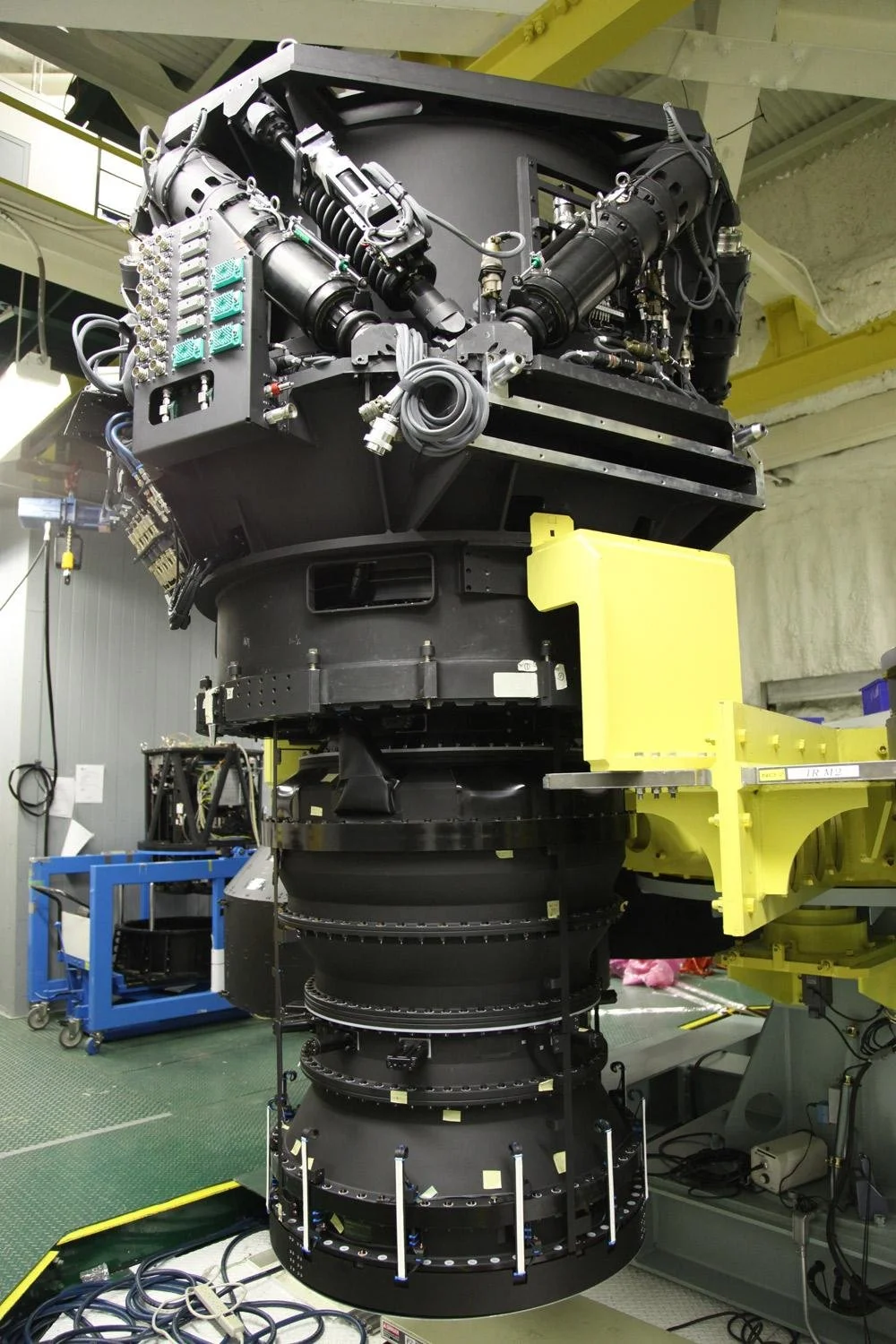
Hyper Suprime-Cam. Photo credit: NAOJ/Subaru Telescope
Conducting such an expansive survey requires all hands on deck. Behind the scenes, Japanese researchers and engineers are supporting the project’s software, systems, and operations with technologies and expertise from the development and operation of the Subaru Telescope’s Hyper Suprime-Cam (HSC).
Since first light in 2012, the Hyper Suprime-Cam has greatly expanded Subaru’s already massive capabilities as one of the largest telescopes in the world. HSC is a giant mosaic camera that extends Subaru’s wide-field imaging capabilities to an outstanding nine times larger than the full moon.
HSC took ten years to develop prior to installation at the Subaru Telescope, followed by another two years after first light before open-use observations began. The time the National Astronomical Observatory of Japan (NAOJ) spent developing, installing, stabilizing, and operating this technology is now lending itself to LSST in a number of ways.
One NAOJ researcher is using expertise from the HSC project to optimize the LSST Camera for stable operations, ensuring the survey collects as much high-quality data as possible each night. In testament to that expertise, HSC observational data collected using those same methods has served as an important verification dataset to ensure a smooth start to LSST operations.
With about 10 terabytes of data collected each night, this survey will yield an enormous data stream by the end of its 10-year timeline. Techniques developed through the HSC project for processing and managing large astronomical datasets are now being used for LSST, ensuring that the data is organized and usable for scientists around the world.
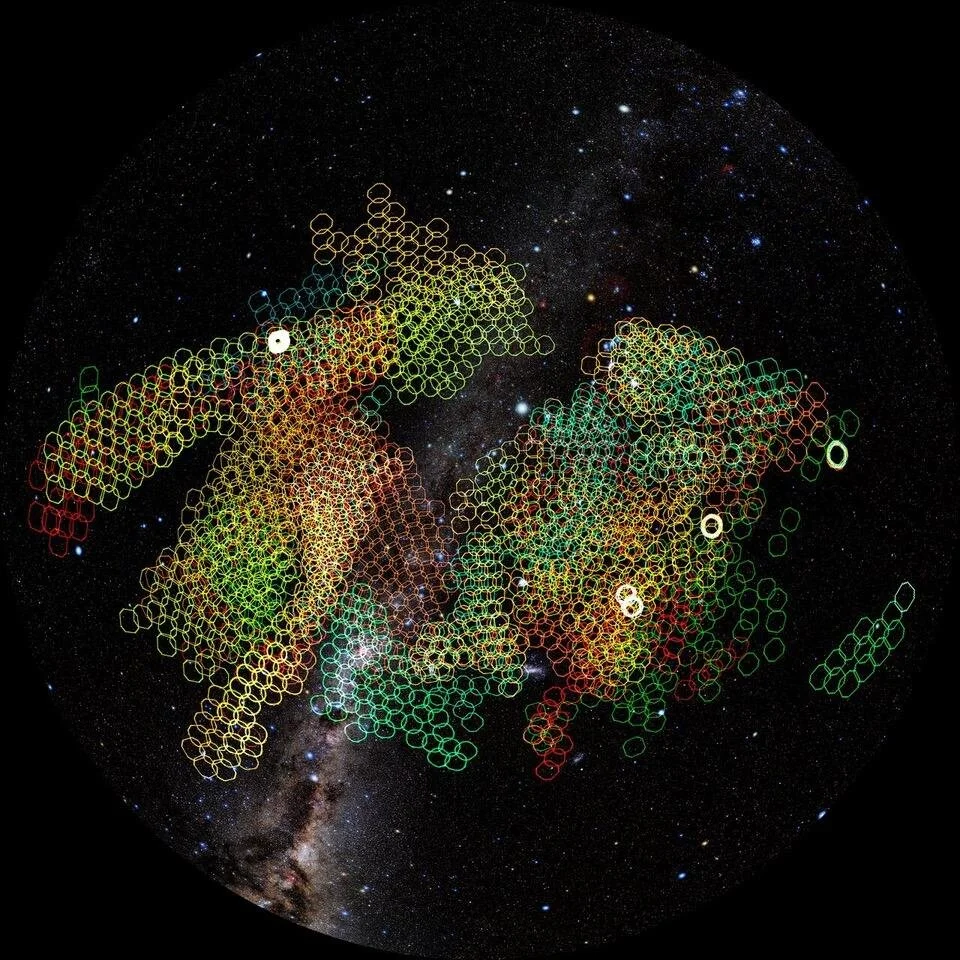
An example of the sky covered by the Legacy Survey of Space and Time (LSST) over the course of one week. Each circle represents the field of view of the LSST Camera, and the different colors indicate the filter used for each exposure (u, g, r, i, z, and y). By repeatedly observing the sky through multiple filters, Rubin Observatory builds a deep, multicolor view of the Universe.
Credit: NSF–DOE Vera C. Rubin Observatory/NOIRLab/SLAC/AURA
Not only does this data need to be organized, it needs to be clean and accurate. An NAOJ engineer is contributing this essential piece of the puzzle by leading the development of visualization software that will validate the data stream. Japanese researchers are also providing computing resources and technical support for the computing environment that will let scientists around the world access and analyze LSST's extensive data archive.
Scientists can use this data to address some of astronomy's biggest questions, including the nature of dark matter and dark energy, the history of the Universe, and the emerging field of multi-messenger astronomy, where observations are coordinated to collect and combine multiple pieces of information at the same time, like light and cosmic rays. More than 80 Japanese researchers have already secured LSST data access rights and are actively engaged in producing world‑leading scientific results.
Rubin Observatory and the Subaru Telescope: A Powerful Partnership
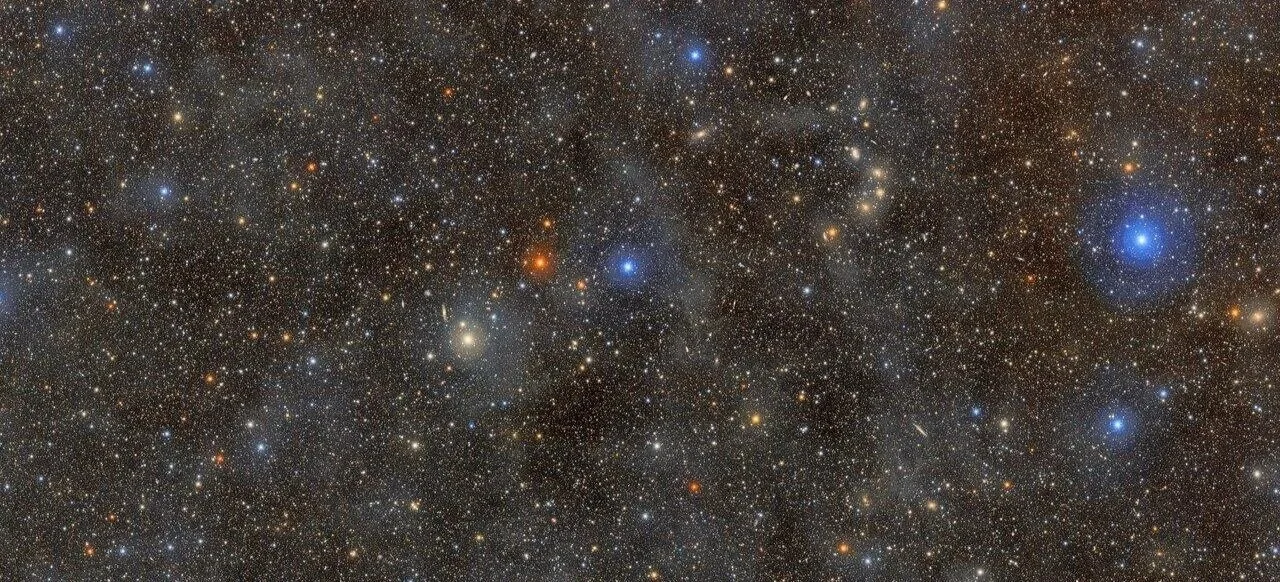
A view toward the constellation Lupus captured by the LSST Camera. Credit: NSF–DOE Vera C. Rubin Observatory/NOIRLab/SLAC/AURA
The complementary strengths of Subaru Telescope and Rubin Observatory enable a powerful observing partnership for the next generation of astronomy. Their respective capabilities position them exceptionally well for the follow-up of short-lived, transient events that can be observed on a human timescale, like supernovae and neutron star mergers.
The Subaru Telescope's advanced observational capabilities are central to this strategy. With the launch of LSST, Rubin Observatory will discover these events in unprecedented numbers. Subaru Telescope’s ʻŌnohiʻula PFS (Prime Focus Spectrograph) will then be able to observe many of these targets simultaneously, allowing them to capture the details of these transient events on an immense scale.
The combination of Rubin's wide-area survey and Subaru Telescope's detailed follow-up observations represents a new observing partnership that will play an important role in international astronomical research. Through international collaboration involving Japan, the United States, and many other partners, a new era of exploration into the origin, evolution, and fundamental mysteries of the Universe is now underway.
