
What was the universe like 900 million years after the Big Bang?
An international team of astronomers is helping answer that question with the discovery of Nāpōwawāʻenakaulua, the oldest and most compact pair of quasars observed at Cosmic Dawn, a period when the universe's earliest stars, galaxies, and black holes were taking shape.
The discovery, made possible through observations using the Gemini North Telescope on Maunakea and the James Webb Space Telescope, raises new questions about how supermassive black holes grew so large, so early in cosmic history.
Two Quasars, One Extraordinary Discovery
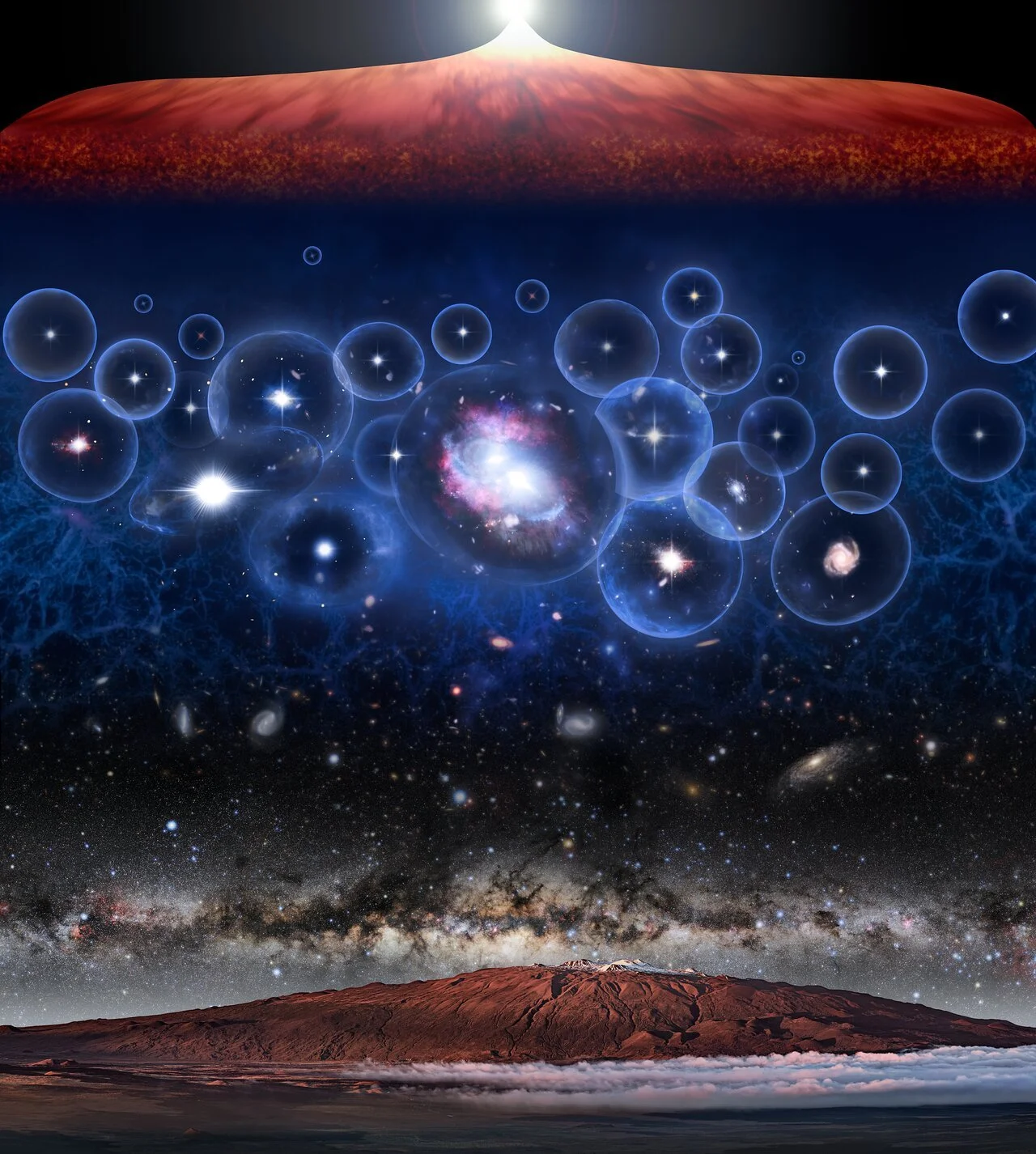
Credit: International Gemini Observatory/NOIRLab/NSF/AURA/P. Marenfeld/M. Zamani
Quasars are among the brightest objects in the universe. Powered by supermassive black holes consuming surrounding gas and dust, they release enormous amounts of energy that can be observed across billions of light-years.
Finding one quasar from the early universe is remarkable. Discovering two so close together offers an even rarer glimpse into the universe’s earliest days.
Nāpōwawāʻenakaulua, also known as J1602+4228AB, consists of two quasars separated by approximately 18,100 light-years. It is only the third known quasar pair discovered from this early period of cosmic history. Despite existing when the universe was only about one-thirteenth of its current age, their central black holes had already grown to masses approximately 1.5 billion and 400 million times that of the Sun, respectively, comparable to the masses of supermassive black holes observed today.
“There is no definitive theoretical explanation for how a single one of these giant quasars exists so early in the age of our universe, much less two,” said Silvia Onorato, postdoctoral research associate at NSF NOIRLab and principal investigator for the discovery.
Observations made with the Gemini Near-Infrared Spectrograph at the Gemini North Telescope on Maunakea were critical in allowing astronomers to distinguish the two quasars, while additional observations with the Gemini Multi-Object Spectrograph helped researchers better understand their properties. Because the objects are so close together and one is exceptionally faint, observing them separately from Earth was expected to be nearly impossible.
Fortunately, perfect timing and perfect conditions during a rare clear night on Maunakea allowed researchers to capture the data they needed.
The discovery provides scientists with a rare opportunity to study how early massive galaxies and their central black holes formed and evolved through interactions between galaxies.
It also builds on a growing body of research from the Maunakea Observatories exploring the early universe, including recent discoveries of the two most distant quasars ever observed. Together, these findings highlight the collective contributions of the Maunakea Observatories in advancing our understanding of Cosmic Dawn.
The Meaning Behind Nāpōwawāʻenakaulua
The discovery continues to carry its meaningful connection to Hawaiʻi through its name: Nāpōwawāʻenakaulua, created by Dr. Larry Kimura, professor at Ka Haka ʻUla O Keʻelikōlani, the University of Hawaiʻi at Hilo’s College of Hawaiian Language.
Dr. Kimura named Nāpōwawāʻenakaulua through A Hua He Inoa, a program led by the ʻImiloa Astronomy Center of Hawaiʻi and Ka Haka ʻUla O Keʻelikōlani that brings together Hawaiian language experts, educators, students, and astronomers to name astronomical discoveries using Hawaiian language and traditional naming practices.
“A Hua He Inoa serves as a model for how multi-knowledge systems lead to a holistic understanding of our universe,” said Dr. Devin Chu, astronomer in residence at the ʻImiloa Astronomy Center of Hawaiʻi. “By grounding astronomical discoveries in Hawaiian language, the program honors Hawaiʻi’s rich cultural heritage.”
The naming process begins with discussions about the properties of a newly discovered astronomical object or instrument. These conversations help Dr. Kimura develop names rooted in Hawaiian language, culture, and knowledge. For Nāpōwawāʻenakaulua, the Kumulipo, a traditional Hawaiian creation chant, served as the foundation for its name.
Nāpōwawāʻenakaulua translates to “Two celestial bodies of fathomless powerful darkness [black holes] in the brilliance of heat reincarnating energy into the Universe.”
The name reflects the nature of the discovery, combining Hawaiian words that describe the two quasars: Nā (plural indicator) and Pō (fathomless powerful darkness), representing the supermassive black holes; Wawā (reincarnation or procreation as referenced from hānau wawā in Pukui-Elbert (1986) dictionary) and ʻEna (brilliance of heat), representing the energy emitted from the matter collecting onto the central black holes; and Kaulua (double or pair), representing the two celestial objects.
The scientific article documenting the discovery underscores the significance of its Hawaiian name, dedicating an entire appendix to explaining the meaning of Nāpōwawāʻenakaulua and recognizing Dr. Kimura and Dr. Chu as coauthors. The paper also cites the Pukui and Elbert Hawaiian dictionary, further acknowledging the Hawaiian language and cultural knowledge that informed the name.
Nāpōwawāʻenakaulua marks the eighth Hawaiian name created through A Hua He Inoa, building on previous discoveries such as Pōwehi, the first black hole ever imaged in 2019, and Pōniuāʻena, which was the most distant quasar known at the time of its discovery in 2020.
Through these names, Hawaiian language and knowledge continue to contribute to how astronomical discoveries are understood and shared with the world.
Advancing Discovery & Inspiring Future Astronomers
Beyond expanding scientific knowledge, the discovery highlights the importance of collaboration between ground-based facilities like the Maunakea Observatories, space telescopes, and the next generation of astronomers.
The research builds on the Aether survey, a James Webb Space Telescope program led by Emanuele Paolo Farina, associate scientist at NSF NOIRLab and Gemini. Using the telescope’s Near-Infrared Spectrograph Integral Field Unit, the survey collected data on 200 quasars, representing 43% of all known quasars from this period of cosmic history. Researchers identified Nāpōwawāʻenakaulua while examining the survey data, with follow-up observations from Gemini North helping establish the nature of the objects.
The survey also provides opportunities for graduate students and early-career researchers like Silvia to make new discoveries, with the team anticipating additional findings as they continue studying the objects identified.
The discovery also presents an opportunity to connect Hawaiʻi Island residents with groundbreaking astronomical research happening on Maunakea.
“I’m excited to share the discovery of Nāpōwawāʻenakaulua with our local students and community,” said Devin.
Devin and Silvia are planning public presentations in Hilo, including through events like Astronomy on Tap and the Journey Through the Universe education program.
As astronomers continue looking deeper into the universe, discoveries like Nāpōwawāʻenakaulua demonstrate how observations from Maunakea, international scientific partnerships, and Hawaiian naming practices collectively contribute to our understanding of the cosmos.
