
Maunakea Scholars Alumni Reconnect at AAS 247 Winter Meeting
Maunakea Scholars: a Launchpad into Astronomy Careers
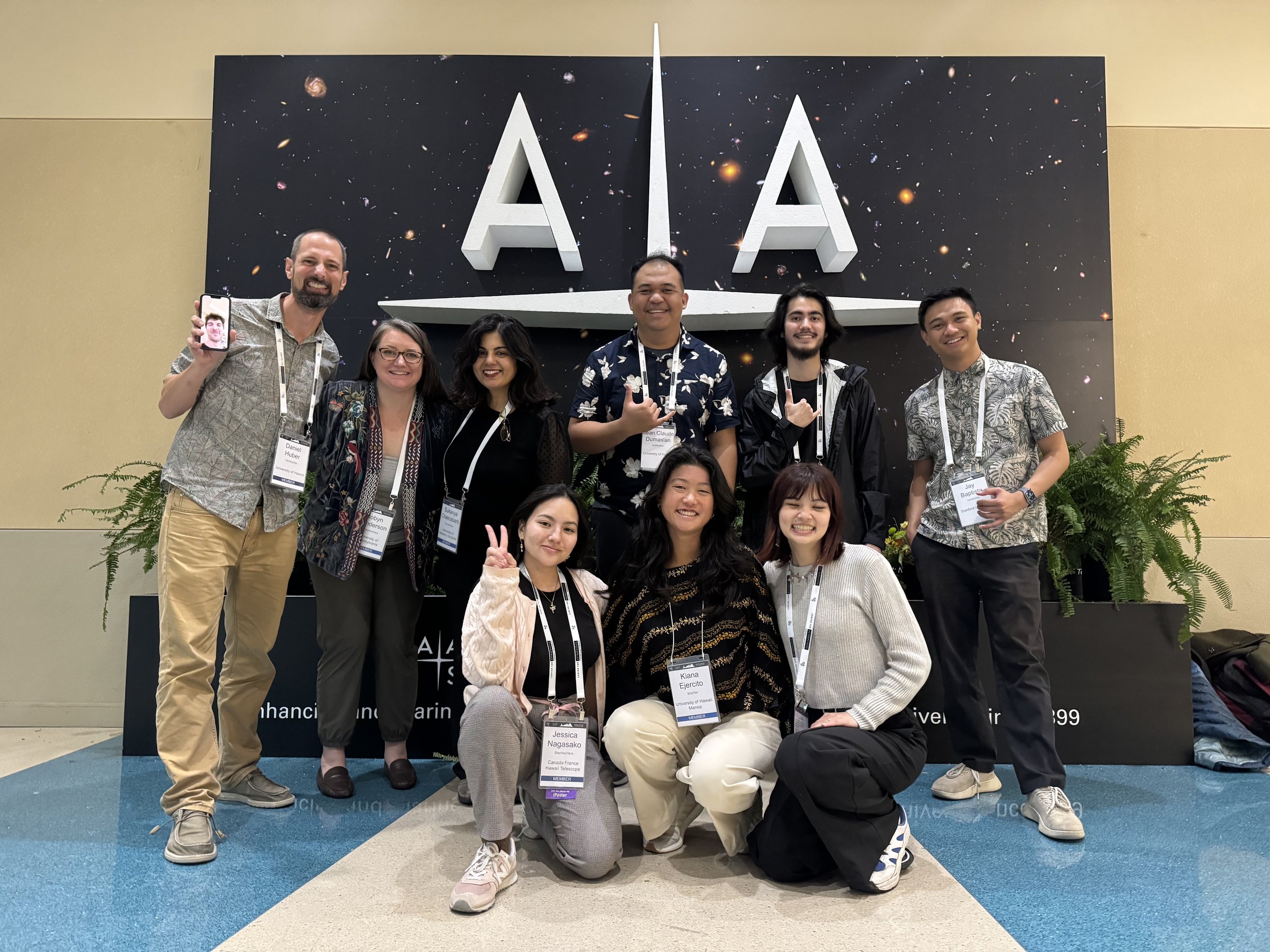
Kiana Ejercito and Jean Claude “JC” Dumaslan both got their start in astronomy through the Maunakea Scholars (MKS) program, which aims to grow the next generation of Hawaiʻi astronomers. MKS provides Hawaiʻi public high school students with mentorship, research experience, and opportunities for observing time with the world-class telescopes on Maunakea. The program has just celebrated its 10-year anniversary and has reached over 1,000 students across Hawaiʻi, powered by University of Hawaiʻi Institute for Astronomy (IfA) director Doug Simons and Maunakea Observatories internship coordinator Mary Beth Laychak. The program opens doors for students to continue pursuing astronomy — which led JC to his current position as a telescope operator for the United Kingdom Infrared Telescope (UKIRT) in Hilo and Kiana to hers as an astrophysics PhD student at the University of California Santa Barbara.
For many students like JC and Kiana, Maunakea Scholars is their first introduction to astronomy research. “MKS was a really good first step to understanding the structure of what being an astronomer is like,” explained Kiana. The same was true for JC, who continued research he’d begun as a Maunakea Scholar on luminous variable stars, making it his senior research project. “Getting to experience doing my own research using Maunakea telescope data, and going up the mountain to visit all the telescopes — it pushed me to go forward with trying to pursue a career in astronomy,” said JC. Both he and Kiana went on to attend the University of Hawaiʻi at Mānoa, with JC receiving a scholarship from Maunakea Scholars to study astronomy.
JC and Kiana both emphasized the importance of the dedicated support provided by the Maunakea Scholars program for years after their participation, especially from Mary Beth and Doug. Kiana described how while her classes and environment can be quite stressful, “programs like MKS and REU [Research Experience for Undergraduates] really helped provide a support system for me. Mary Beth and Doug have been such supportive mentors to me this whole time. I definitely wouldn’t have made it so far without them,” she elaborated. JC continued, “I don’t think I would be where I am today without the help of all those people. I felt very welcome and very lucky.” The relationships they formed with MKS staff as well as their fellow cohort members carry on for many years.
Mentorship and Close Cohorts
JC shared that being part of a small cohort meant they were able to get more in-depth help and form connections with their mentors, who are researchers from the observatories and UH staff, as well as graduate and postdoctoral students who often served as role models and supporters. “Our mentors pushed us in the right direction when we got stuck,” said JC. Kiana echoed that sentiment, in particular about her graduate student advisor, who left a real lasting impact on her. She helped guide Kiana through her project as an MKS student and gave her useful advice about building astronomy research skills and, most importantly, modeled a future pathway in astronomy — and Kiana has ended up following in her footsteps. “Before, being an astronomer was this vague goal in my head,” said Kiana, “but after talking with her and doing MKS, I saw all the components that go into doing astronomy" which gave her a clearer picture of what she wanted to pursue.
At UH Mānoa, both Kiana and JC progressed through Research Experience for Undergraduates (REU), which brings local college students together for a summer research project at the Institute for Astronomy. REU is a cohort-style program, where students pursue separate research projects united under a common theme. This model allowed JC and Kiana to develop genuine relationships with their cohort and made the research extremely enjoyable. JC described, “That’s the main idea of the culture of Hawaiʻi — bringing a lot of people working together like a family, doing something we all enjoy.”
Supporting Local Kids in Astronomy
Both Kiana and JC have been inspired by MKS’s supportive mentorship and outreach to local students, driving them to inspire younger students interested in astronomy. JC has gone back to his high school to give talks about his college experience in astrophysics and share about the opportunities local Hawaiʻi students have here at home. He also loves volunteering at AstroDay events where he gets to interact with students. “I love advocating for things that help people, and these students are on the edge of trying to figure out what they want to do at this age,” said JC. ”Telling them there’s a whole world of things you can do, you just have to reach out and try — and then seeing students go for it and be successful. That’s the best part.”
The mentorship and support she’s received from being part of Maunakea Scholars and REU have also inspired Kiana to help younger students understand what being an astronomer is like. “Being part of a program where I’ve received such supportive mentorship makes me want to give back,” said Kiana. She was motivated to join the Society of Physics Students at UH Mānoa, eventually serving as president. In her role, she organized opportunities for undergrads in physics, like lunches with professors and undergrad-grad socials.
‘Standing on the Shoulders of Giants’
Jay Baptista (2021 REU student), JC, Mary-Beth, Doug Simons, Kiana, Jason Lau, Jessica Nagasako (2022 REU student)
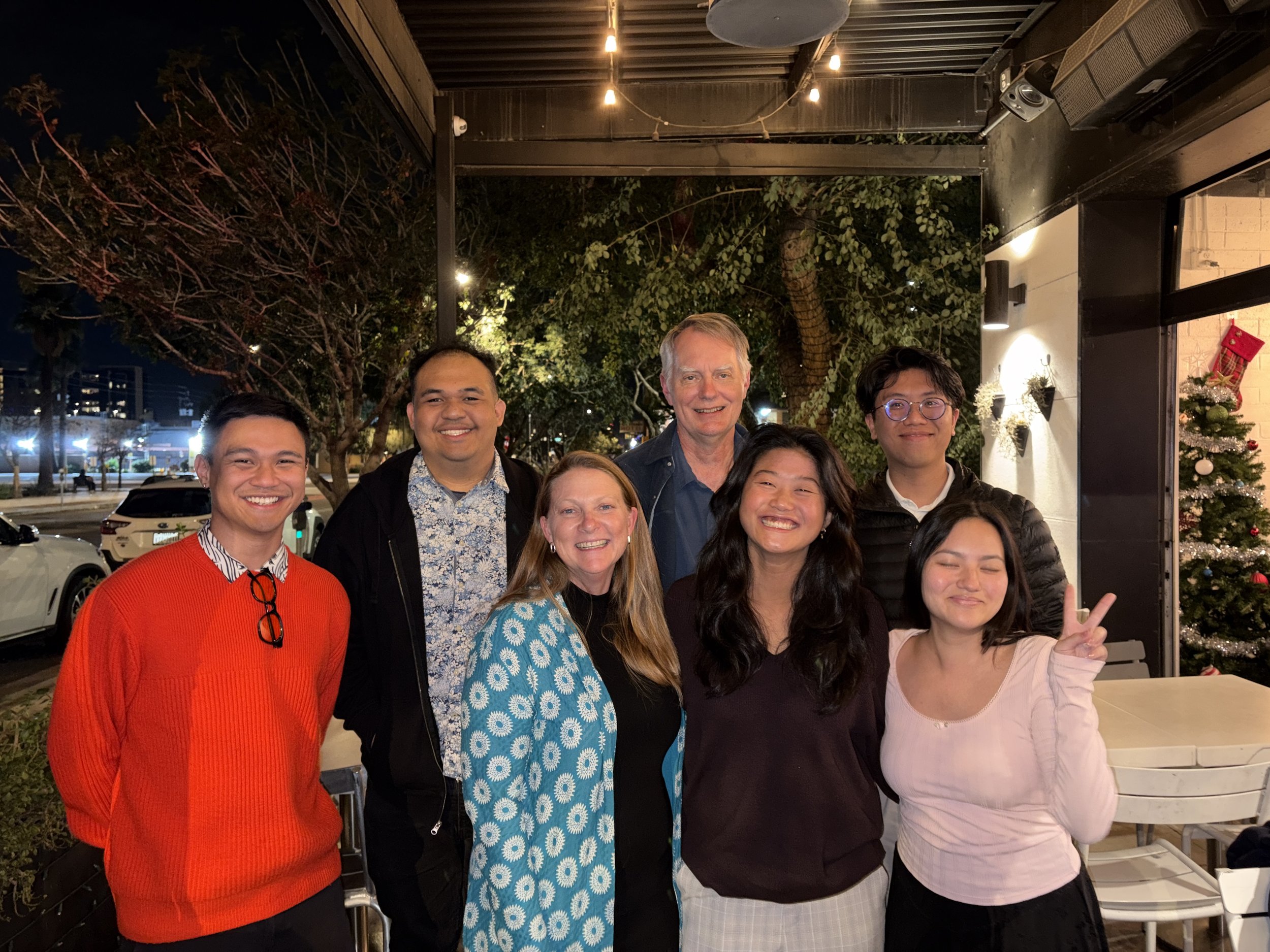
AAS 247 brought together three different cohorts of past REU students, a few of whom are also MKS alumni. JC and Kiana were part of the 2022 REU cohort and presented along with students from the 2021 and 2023 cohorts. Some of these students worked on multi-year projects, so the summit allowed them to meet generations of student researchers contributing to the same mission. “To me it really exemplified the quote, ‘standing on the shoulders of giants,’” said Kiana. “I’m really proud of all my fellow cohort members, to see them go on and do amazing things.”
What tied together all of the students’ presentations was the use of astroseismology, or using the pulsations of a star’s light to determine the characteristics of the star. “Since we can’t physically touch stars, we look at the variations of a star’s light,” explained JC, and that can tell them a lot about the internal structure of a star, its composition, density, and its age. The name astroseismology is because the method is similar to how seismology, or the study of earthquakes, determines that the Earth’s interior is made up of layers like the crust, mantle, outer core, and inner core.
JC’s work specifically proved it was possible to use ground-based telescopes like those on Maunakea, rather than only telescopes orbiting in space, to determine the frequency and patterns of the stars’ pulsations. There are many applications for this work — for example, one group’s research focused on using the patterns of stars’ light pulsations as a time/distance measurement to create a 3D map of the Milky Way galaxy. Kiana’s focus was primarily on using those patterns to look for small, star-sized black holes orbiting around stars, also known as “dark companions.”
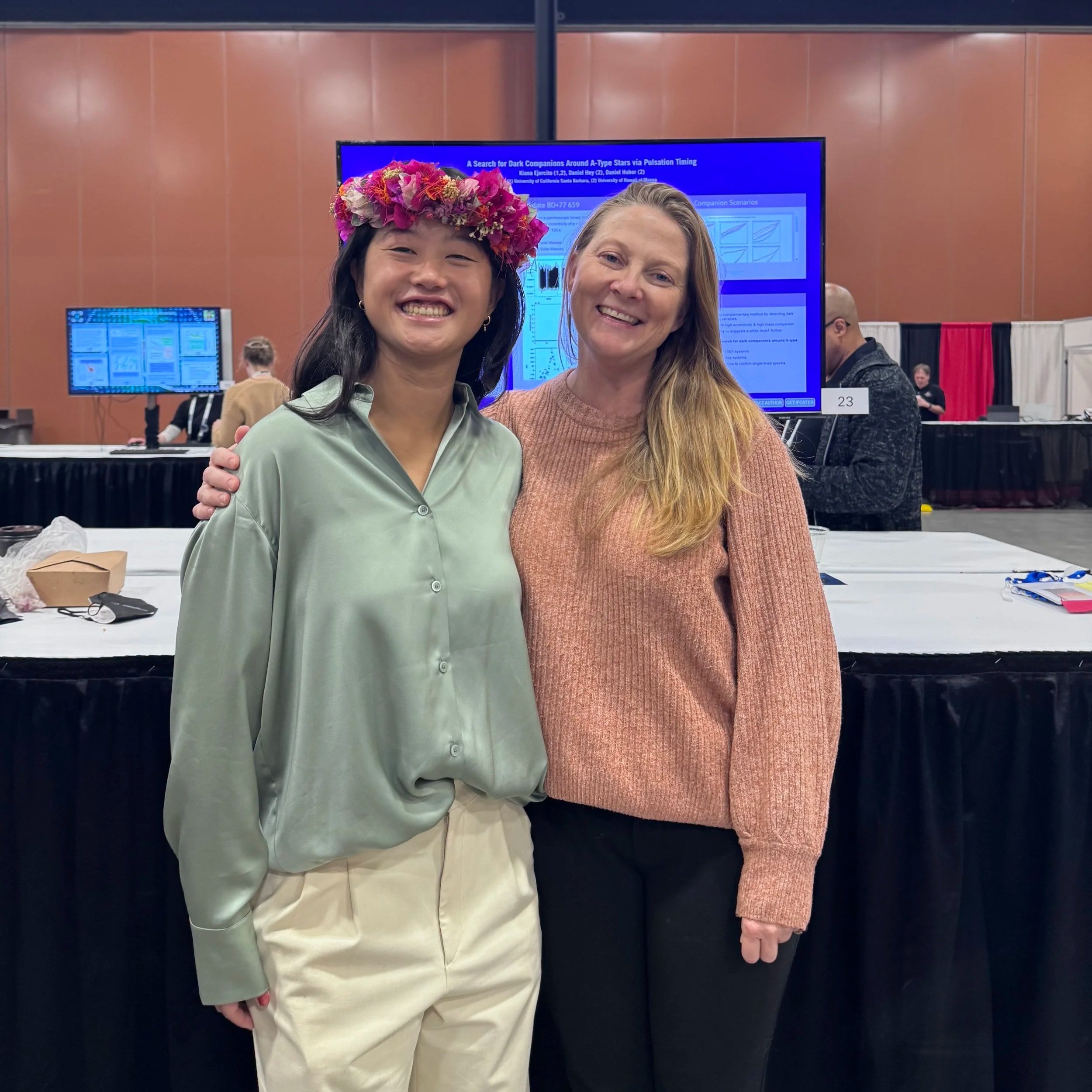
At the summit, JC remarked on the similarities between astronomy outreach between Hawaiʻi and Arizona, where the summit was held. Astronomers in both places are strongly focused on uplifting indigenous astronomy expertise and cultural histories and connecting with local Native students. “The amount of effort going into that in both places is amazing,” he continued. Coming to the summit and learning about those efforts in Arizona resonated with JC, as he saw how both programs are working to bridge the connection with local students, both culturally and scientifically.
For Kiana, reuniting with the Hawaiʻi-based research team at AAS 247 reminded her just how important the collaborative aspect of science is. “Reaching out to people and building a strong community is really important,” she said. Now at UC Santa Barbara, she works in the Mazin Lab on microwave kinetic inductance detectors and emphasized how important teamwork and supporting each other are for her lab. Even though academia can be competitive, she says the actual day-to-day requires strong collaboration. “Our experiments literally cannot run with just one person operating them," she explained. That collaboration, mentorship, and community are what make astronomy possible.
‘Take the Leap’
JC and Kiana’s main advice to any local kids interested in astronomy is to just go for it and don’t be afraid of trying something new or failing. Science is marked by challenges and setbacks, but as JC said, a failure in research is just a sign that there’s a better method or a new method out there. Kiana expanded, “Aim for every opportunity that is available, even if you don’t think you’re going to get it,” whether it’s sending a cold email or applying for a program.
“It’s really inspiring to see local Hawaiʻi kids be so supported in astronomy,” both by their mentors and their fellow students. Knowing that there’s a whole community out there of Hawaiʻi astronomers rooting for you and looking out for you, long into your future, continues to keep alumni like JC and Kiana motivated and connected.
